Key takeaways
- MOTS-c is a 16-amino-acid peptide encoded within the mitochondrial 12S rRNA gene, first characterized by Changhan Lee and Pinchas Cohen’s group in 2015.
- In mice, exogenous MOTS-c activated AMPK, limited diet-induced weight gain, and improved insulin sensitivity; the effect depended on the folate–methionine cycle.
- Endogenous MOTS-c rises in human skeletal muscle after exercise, and treatment of aged mice improved running capacity, which is why it is called an “exercise mimetic.”
- Human clinical data remain limited to one 20-participant phase 1b study of a modified analog, CB4211; the native peptide has not been tested in a controlled human trial.
Most peptides that attract research attention are encoded in the nucleus. MOTS-c is different. It is transcribed from a short open reading frame inside the mitochondrial genome, in a stretch of DNA that biologists had long assumed coded only for a ribosomal RNA. That origin makes it one of a small family of mitochondrial-derived peptides (MDPs), and it explains why the compound has become a fixture of metabolic and aging research over the past decade. The interest is not in what MOTS-c does to mitochondria so much as in what mitochondria appear to be saying to the rest of the cell through it. This note reviews the primary literature, separates the animal data from the small amount of human data, and marks where the evidence runs out.
Where MOTS-c comes from
Human mitochondrial DNA is a compact 16.6-kilobase circle that was thought to encode 13 proteins, 22 transfer RNAs and two ribosomal RNAs. In 2015, Lee, Cohen and colleagues reported that the 12S rRNA gene also contains a short open reading frame whose transcript, once exported and translated in the cytoplasm, yields a 16-amino-acid peptide. They named it MOTS-c, for mitochondrial open reading frame of the 12S rRNA type-c.1 The peptide was detected in multiple mouse and human tissues and in circulating plasma, and its levels fell in skeletal muscle and plasma with age.
The finding placed MOTS-c alongside humanin, the first MDP described in 2001, and the small humanin-like peptides (SHLPs) described in 2016. We cover the broader family in Mitochondrial-Derived Peptides: MOTS-c, Humanin and SHLPs.
The 2015 Cell Metabolism study
The discovery paper did more than identify the peptide. In cultured cells, MOTS-c inhibited the folate cycle and de novo purine biosynthesis, causing accumulation of the intermediate AICAR, an endogenous activator of AMP-activated protein kinase (AMPK). AMPK is a central energy sensor; when activated it promotes glucose uptake and fatty-acid oxidation and suppresses anabolic pathways. The authors showed that MOTS-c-driven AMPK activation depended on this folate–methionine cycle route rather than on direct kinase binding.1
In vivo, mice fed a high-fat diet and given daily MOTS-c injections gained less weight than vehicle-treated controls, without a measurable difference in food intake. Treated animals showed lower fasting insulin, improved glucose tolerance, and, on hyperinsulinemic-euglycemic clamp testing, better skeletal-muscle insulin sensitivity. Aged mice on a normal diet also showed improved insulin sensitivity after treatment.1 These were pharmacological experiments in rodents. They established a plausible mechanism and a reproducible phenotype, not a human outcome.
Reading the evidence
The 2015 paper is a mechanism-plus-phenotype study in mice and cell lines. When a later article describes MOTS-c as “improving insulin sensitivity,” it is almost always pointing back to these clamp experiments in rodents, not to any human trial.
Translocation to the nucleus
A 2018 follow-up from the same laboratory answered a question the first paper left open: how does a peptide made from mitochondrial DNA change nuclear gene expression? Kim, Son, Benayoun and Lee showed that under metabolic stress (glucose restriction, or oxidative stress induced by tert-butyl hydroperoxide) MOTS-c moved from the cytoplasm into the nucleus. There it associated with chromatin and with transcription factors including NRF2, regulating genes involved in the antioxidant response and in stress adaptation. Translocation depended on AMPK activity.2
This established MOTS-c as a retrograde signal: a message that originates in the mitochondrion and alters the nuclear program. Cells expressing MOTS-c were more resistant to glucose deprivation, and mitochondrial-to-nuclear communication of this kind is now a recognized theme in aging biology. It remains cell-culture evidence, and the extent to which nuclear translocation occurs in intact human tissue has not been directly demonstrated.
Exercise studies and the “exercise mimetic” label
The most-cited MOTS-c paper after the original is Reynolds and colleagues’ 2021 Nature Communications study.3 It combined human and mouse work. In healthy young men who completed a stationary-cycling protocol, MOTS-c levels in skeletal-muscle biopsies rose roughly twelvefold relative to pre-exercise baseline and remained elevated into recovery; plasma levels also increased. This is the principal human observation in the MOTS-c literature, and it concerns the endogenous peptide, not administration of anything.
The mouse experiments tested exogenous peptide. Young, middle-aged and old mice given MOTS-c ran farther and longer on a treadmill than controls. In young mice on a high-fat diet, the higher dose group had every animal reach the final sprint speed, compared with a minority of controls. Old mice roughly doubled running time and distance. In a separate arm, treatment started at about 23.5 months of age, near the end of life for that strain, and was continued three times weekly; the treated animals showed better grip strength, gait and walking capacity, along with a non-significant trend toward longer median survival.3
The phrase “exercise mimetic” comes from these results. It should be read narrowly: in mice, the peptide reproduced some of the physical-performance and metabolic adaptations that exercise produces. The human component of the study shows that exercise raises MOTS-c; it does not show that raising MOTS-c does anything in people.
Exercise raises MOTS-c in human muscle; the claim that MOTS-c substitutes for exercise has only been tested in mice.
Genetics and population studies
Two human genetic observations are worth noting because they are frequently mis-cited. Fuku and colleagues reported in 2015 that the mitochondrial variant m.1382A>C, which changes residue 14 of MOTS-c from lysine to glutamine (K14Q), is common in Northeast Asian populations and is more frequent in Japanese centenarians than in controls, prompting the hypothesis that MOTS-c might contribute to exceptional longevity.4 Zempo and colleagues followed up in 2021 in large Japanese cohorts and found the same variant associated with higher type 2 diabetes risk in men, particularly those with low physical activity; the K14Q peptide was less effective than wild-type MOTS-c in the group’s mouse and cell assays.5 The two findings are not necessarily contradictory (a variant could carry different risks in different contexts), but they illustrate that the human data are associations, and small ones.
Human trials: CB4211
The only controlled clinical trial in this area did not use native MOTS-c. CohBar, a company co-founded by Cohen, developed CB4211, a chemically modified MOTS-c analog designed for longer half-life, and ran a phase 1a/1b program. The phase 1a stage enrolled 65 healthy adults in single- and multiple-ascending-dose cohorts to assess safety and pharmacokinetics. The phase 1b stage randomized 20 participants with obesity and nonalcoholic fatty liver disease (liver fat at least 10 percent at baseline) to daily subcutaneous CB4211 or placebo for four weeks.7
Topline results announced in August 2021 reported that the compound was well tolerated with no serious adverse events, although injection-site reactions occurred in more than 10 percent of treated participants. Among exploratory endpoints, the active group showed statistically significant reductions relative to placebo in ALT, AST and fasting glucose. Body weight trended downward without reaching significance, and liver-fat reduction was essentially the same in both arms.7 The study was small, short, and published only as a press release and a conference late-breaker; CohBar later merged and the program was not advanced. This is the entirety of the controlled human evidence, and it concerns an analog rather than the peptide sold for research.
| Evidence tier | What was studied | Key observations | Limits |
|---|---|---|---|
| In vitro | HEK293, myoblast and other cell lines1,2 | Folate-cycle inhibition, AICAR accumulation, AMPK activation; nuclear translocation under stress | Supra-physiological concentrations; no tissue context |
| In vivo (rodent) | High-fat-diet, aged and late-life mice1,3 | Less weight gain, better insulin sensitivity, greater running capacity, improved grip and gait | Daily or thrice-weekly injections; species differences in MOTS-c sequence |
| Human observational | Exercise biopsies; mtDNA cohorts3,4,5 | Endogenous MOTS-c rises with exercise; K14Q variant linked to longevity and to diabetes risk | Associations only; no intervention |
| Human interventional | CB4211 analog, phase 1a/1b7 | Tolerable; lower ALT, AST, glucose vs placebo at 4 weeks | n=20; analog, not native peptide; press-release data |
Open questions
Several matters remain unresolved. The receptor or transporter through which extracellular MOTS-c enters cells has not been identified. Pharmacokinetics of the native peptide in humans are unpublished; a 16-residue linear peptide would be expected to clear quickly, which is one reason CohBar engineered a modified analog. The dose–response relationship across species is uncertain, since the mouse and human MOTS-c sequences differ. And no study has yet tested whether the mouse exercise-capacity findings translate to any human outcome.6
One regulatory point is relevant to how the compound is discussed. MOTS-c appears on the World Anti-Doping Agency Prohibited List, reflecting its classification as a potential metabolic modulator in sport.8 That listing is a statement about doping policy, not about efficacy.
Limits of the record
MOTS-c has no approved pharmaceutical form anywhere, and the native peptide has never been tested in a controlled human trial. Research-grade material is supplied for laboratory investigation only. Wednesday publishes its lot-specific analytical data in the COA library; see our catalog guide for how identity and purity are reported.
How MOTS-c fits the wider metabolic literature
Researchers interested in MOTS-c usually arrive from one of two directions. The first is incretin pharmacology, where GLP-1 receptor agonists and multi-receptor agonists act on appetite and insulin secretion through hormone receptors; we cover that field in What Are GLP-1 Peptides? MOTS-c is mechanistically unrelated. It does not act on a known cell-surface receptor and its metabolic effects in mice were not accompanied by reduced food intake. The second direction is mitochondrial biology and NAD+ metabolism, where AMPK and sirtuin signaling are central; see What Is NAD+? MOTS-c sits more naturally in this second category, as a mitochondrially encoded signal that converges on AMPK.9
The literature is coherent, largely from a single research lineage, and still awaiting independent replication at scale.
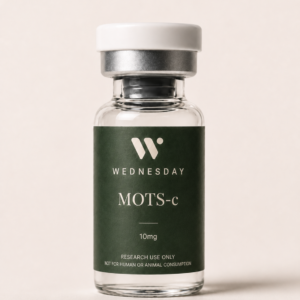 Metabolic Signaling Research
MOTS-c
10 mg View listing →
Metabolic Signaling Research
MOTS-c
10 mg View listing →
Frequently asked questions
What is MOTS-c?
MOTS-c is a 16-amino-acid peptide encoded by a short open reading frame within the mitochondrial 12S ribosomal RNA gene. It was first described in 2015 and belongs to the class of mitochondrial-derived peptides. In cell and mouse studies it activates AMPK indirectly through the folate–methionine cycle and can move into the nucleus under metabolic stress.
Is MOTS-c an exercise mimetic?
The term comes from a 2021 mouse study in which MOTS-c treatment improved treadmill running capacity and physical function in young, old and late-life animals. The same paper showed that exercise raises endogenous MOTS-c in human muscle. No human study has tested whether administering MOTS-c reproduces exercise adaptations in people.
Has MOTS-c been tested in humans?
Native MOTS-c has not been evaluated in a controlled clinical trial. A modified analog, CB4211, completed a phase 1a/1b program in which 20 participants with obesity and fatty liver received the compound or placebo for four weeks. It was tolerated and showed lower liver enzymes and glucose than placebo, but the program was not continued.
How does MOTS-c activate AMPK?
In the 2015 discovery paper, MOTS-c inhibited the folate cycle and de novo purine synthesis, leading to accumulation of AICAR, a metabolite that activates AMPK. This is an indirect route; MOTS-c does not bind AMPK directly. AMPK activation in turn promoted glucose uptake and fatty-acid utilization in the models studied.
Is MOTS-c banned in sport?
Yes. MOTS-c is listed on the World Anti-Doping Agency Prohibited List. Athletes subject to anti-doping rules should treat it as prohibited at all times.
References & further reading
- Lee C, Zeng J, Drew BG, et al. The mitochondrial-derived peptide MOTS-c promotes metabolic homeostasis and reduces obesity and insulin resistance. Cell Metab. 2015;21(3):443–454. doi:10.1016/j.cmet.2015.02.009 / PMID 25738453
- Kim KH, Son JM, Benayoun BA, Lee C. The mitochondrial-encoded peptide MOTS-c translocates to the nucleus to regulate nuclear gene expression in response to metabolic stress. Cell Metab. 2018;28(3):516–524.e7. doi:10.1016/j.cmet.2018.06.008 / PMID 29983246
- Reynolds JC, Lai RW, Woodhead JST, et al. MOTS-c is an exercise-induced mitochondrial-encoded regulator of age-dependent physical decline and muscle homeostasis. Nat Commun. 2021;12:470. doi:10.1038/s41467-020-20790-0
- Fuku N, Pareja-Galeano H, Zempo H, et al. The mitochondrial-derived peptide MOTS-c: a player in exceptional longevity? Aging Cell. 2015;14(6):921–923. doi:10.1111/acel.12389 / PMID 26289118
- Zempo H, Kim SJ, Fuku N, et al. A pro-diabetogenic mtDNA polymorphism in the mitochondrial-derived peptide, MOTS-c. Aging (Albany NY). 2021;13(2):1692–1717. doi:10.18632/aging.202529
- Miller B, Kim SJ, Kumagai H, Yen K, Cohen P. Mitochondria-derived peptides in aging and healthspan. J Clin Invest. 2022;132(9):e158449. doi:10.1172/JCI158449 / PMID 35499074
- CohBar, Inc. CohBar announces positive topline results from the phase 1a/1b study of CB4211 under development for NASH and obesity. Press release, 10 August 2021. GlobeNewswire
- U.S. Anti-Doping Agency. What is the MOTS-c peptide? usada.org
- Lee C, Kim KH, Cohen P. MOTS-c: a novel mitochondrial-derived peptide regulating muscle and fat metabolism. Free Radic Biol Med. 2016;100:182–187. PMID 27216708