Key takeaways
- GLP-1 is a 30-amino-acid gut hormone cleaved from proglucagon and released from intestinal L-cells after a meal; it is one of two incretins that amplify insulin secretion in response to glucose.
- Native GLP-1 is inactivated within about two minutes by the enzyme DPP-4, which is why every therapeutic analogue is a structural redesign to resist degradation.
- GLP-1 receptor signaling slows gastric emptying, suppresses glucagon and acts in the brain to reduce food intake; the approved drugs are pharmaceutical products with extensive human trials.
- Research-grade GLP-1 class peptides are laboratory reagents, not those drugs, and the multi-agonist compounds that followed them are still under investigation.
Glucagon-like peptide-1 has moved in forty years from an obscure product of proglucagon processing to the basis of the most consequential drug class in metabolic medicine. For researchers, though, the pharmaceutical story is only the end of a longer scientific one about how the gut talks to the pancreas and the brain. GLP-1 is a hormone with a half-life measured in minutes, receptors spread across a dozen tissues, and effects that reach from insulin secretion to appetite. Understanding that biology is the prerequisite for making sense of the analogues built on it, the dual and triple agonists that extended the concept, and the research compounds that share the class name. This note is the foundation for the Metabolic & GLP section of the library.
Where GLP-1 comes from
GLP-1 is encoded by the proglucagon gene, the same gene that encodes glucagon. The 160-amino-acid proglucagon precursor is processed differently depending on the cell. In pancreatic alpha cells, prohormone convertase 2 releases glucagon. In intestinal L-cells and in a small population of brainstem neurons, prohormone convertase 1/3 releases GLP-1, GLP-2 and oxyntomodulin instead.1 The biologically active forms are GLP-1(7-36) amide and GLP-1(7-37), both 30–31 residues long. The peptide’s name reflects its origin, it is glucagon-like because it comes from the same precursor, not a similarity of function; in most respects GLP-1 and glucagon oppose each other.
L-cells are concentrated in the distal small intestine and colon but are present throughout the gut. They release GLP-1 within minutes of nutrient ingestion, a response fast enough that a neural or proximal-gut signal is thought to contribute alongside direct nutrient sensing.
The incretin effect
The concept that makes GLP-1 important predates its discovery. Oral glucose produces a much larger insulin response than the same glucose given intravenously to match blood levels, and the difference, the incretin effect, accounts for up to two-thirds of post-meal insulin secretion in healthy people. Two hormones are responsible: glucose-dependent insulinotropic polypeptide (GIP), identified in the 1970s, and GLP-1, whose insulinotropic action in humans was demonstrated by Kreymann and colleagues in 1987.2
The critical property is glucose dependence. GLP-1 stimulates insulin only when blood glucose is elevated, so it does not cause hypoglycemia on its own. Equally important for drug development was a 1993 finding by Nauck and colleagues: in people with type 2 diabetes, the insulinotropic effect of GIP was largely lost, but the effect of GLP-1 was preserved.3 That single observation directed the next two decades of pharmacology toward GLP-1 and away from GIP, a choice that was later revisited, as the sibling note GLP-1 vs. GIP vs. Glucagon Receptors explains.
What GLP-1 does
The GLP-1 receptor is a class B G-protein-coupled receptor that signals mainly through Gαs and cyclic AMP. Its distribution explains the hormone’s range of effects, comprehensively reviewed by Drucker and by the Müller consensus group.1,4
- Pancreatic beta cells: cAMP potentiates glucose-stimulated insulin secretion and supports insulin gene transcription; in rodents, GLP-1 also promotes beta-cell proliferation and survival, an effect not clearly reproduced in humans.
- Pancreatic alpha cells: GLP-1 suppresses glucagon secretion when glucose is high, probably indirectly through somatostatin and insulin.
- Stomach: GLP-1 slows gastric emptying via vagal pathways, flattening post-meal glucose excursions.
- Brain: receptors in the hypothalamus, brainstem and reward circuits mediate reduced food intake and earlier satiety; this is the mechanism behind the weight effects of the drug class.
- Heart and vasculature: receptors are present in the atrium and vessels; the mechanism of the cardiovascular outcomes seen in trials is still debated.
GLP-1 is a two-minute hormone that took thirty years of chemistry to turn into a one-week drug.
The two-minute problem
Native GLP-1 has a plasma half-life of roughly two minutes. The enzyme dipeptidyl peptidase-4 (DPP-4) cleaves the N-terminal two residues, His-Ala, converting active GLP-1(7-36) into inactive GLP-1(9-36). Renal clearance removes what remains. This is why infusing native GLP-1, while informative in physiology studies, was never a viable therapy, and it defined the engineering problem for the entire class: how to keep a peptide that must retain its N-terminus for receptor binding away from an enzyme that attacks exactly that end.4
How analogues were built
Three strategies emerged, and they are worth knowing because they recur in every later multi-agonist.
| Strategy | How it works | Examples | Approximate half-life |
|---|---|---|---|
| Borrow a resistant sequence | Exendin-4, a peptide from Gila monster venom, activates GLP-1R but has a glycine at position 2 that DPP-4 cannot cleave | Exenatide, lixisenatide | 2–4 hours |
| Substitute position 2 and add a fatty acid | Replacing Ala8 with a non-natural amino acid blocks DPP-4; a lipid side chain binds albumin, shielding the peptide from renal clearance | Liraglutide (C16 acyl, daily), semaglutide (C18 diacid on a spacer, weekly) | 13 hours to 7 days |
| Fuse to a large carrier | Attaching the peptide to albumin or an antibody Fc fragment raises molecular weight above the renal filtration threshold | Dulaglutide (Fc fusion), albiglutide | About 5 days |
Semaglutide illustrates how far the concept has been taken: an amino acid substitution at position 8, a lysine substitution at position 34 to control where the lipid attaches, and a C18 fatty diacid on a hydrophilic spacer that gives very tight albumin binding. The result is a once-weekly peptide, and subsequently an oral formulation using an absorption enhancer. The same toolkit, position-2 protection and lipidation, underlies tirzepatide and the triple agonists discussed in Semaglutide vs. Tirzepatide and Triple GLP-1/GIP/Glucagon Agonists.
The clinical record, briefly
GLP-1 receptor agonists have the deepest human evidence base of any peptide class. In SUSTAIN-6, semaglutide reduced major adverse cardiovascular events in people with type 2 diabetes;5 in STEP 1, participants with obesity lost a mean of about 15% of body weight over 68 weeks against 2.4% on placebo;6 and in SELECT, semaglutide reduced cardiovascular events in people with obesity who did not have diabetes.7 These are findings about approved pharmaceutical products at tested doses in monitored populations. The common adverse effects across trials were gastrointestinal, nausea, vomiting, diarrhea, consistent with the gastric-emptying mechanism.
Reading the evidence
The GLP-1 clinical trials describe approved drugs manufactured under pharmaceutical quality systems. Research-grade GLP-1 class peptides are laboratory reagents sold for in vitro and preclinical use. They are not the approved products, and trial results do not transfer to them. Wednesday does not sell semaglutide or tirzepatide.
From single agonism to multi-agonism
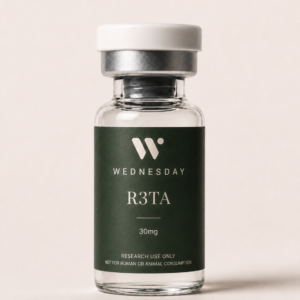
The GLP-1 story did not end with better GLP-1 analogues. Once it was clear that a lipidated, DPP-4-resistant peptide could be made to last a week, chemists asked whether one molecule could activate more than one receptor in the proglucagon family. Tirzepatide added GIP receptor activity; the triple agonists added glucagon receptor activity as well, on the rationale that glucagon raises energy expenditure while GLP-1 and GIP restrain the glucose-raising effect. Wednesday’s catalog lists R3TA (30 mg), a triple GLP-1/GIP/glucagon receptor agonist under investigation, for laboratory research; its research status and the phase 2 literature behind the class are covered in Triple GLP-1/GIP/Glucagon Agonists: Where the Research Stands. Certificates of analysis for research compounds are in the COA library.
Why researchers work with GLP-1 class peptides
For a laboratory, GLP-1 and its analogues are tools for studying class B GPCR signaling, receptor trafficking and biased agonism, incretin physiology in isolated islets and perfused pancreas, central appetite circuits in rodents, and the pharmacokinetics of lipidated peptides. Analytical chemists use them as model compounds for the HPLC and mass-spectrometry methods that verify long, modified peptides, see What Is HPLC?. The biology is well mapped, which makes the class a good reference system, and still unfinished, which makes it worth studying.
 Metabolic Signaling Research
R3TA
30 mg, triple agonist for laboratory research View listing →
Metabolic Signaling Research
R3TA
30 mg, triple agonist for laboratory research View listing →
Frequently asked questions
What is GLP-1 and where is it produced?
GLP-1 is a 30-amino-acid hormone cleaved from proglucagon in intestinal L-cells and a small population of brainstem neurons. It is released within minutes of eating and acts on receptors in the pancreas, stomach, brain and heart.
What is the incretin effect?
Oral glucose triggers far more insulin than the same glucose given intravenously. The difference is due to gut hormones, GLP-1 and GIP, that amplify glucose-stimulated insulin secretion. In type 2 diabetes the effect of GIP is blunted while GLP-1 remains active, which is why early drugs targeted GLP-1.
Why does native GLP-1 not work as a drug?
The enzyme DPP-4 cleaves its first two amino acids within about two minutes, inactivating it. Therapeutic analogues resist DPP-4 by substituting the vulnerable residue and extend their circulation time with fatty-acid side chains or large carrier proteins.
What is the difference between a GLP-1 agonist and a dual or triple agonist?
A GLP-1 agonist activates only the GLP-1 receptor. Dual agonists such as tirzepatide also activate the GIP receptor. Triple agonists add glucagon receptor activity. All three types are built from the same lipidated, DPP-4-resistant peptide chemistry.
Are research-grade GLP-1 peptides the same as the approved drugs?
No. Approved GLP-1 medicines are pharmaceutical products with clinical trial data at specified doses. Research-grade peptides are reagents for laboratory use, sold without those data and not intended for administration to people.
References & further reading
- Drucker DJ. Mechanisms of action and therapeutic application of glucagon-like peptide-1. Cell Metab. 2018;27(4):740–756. doi:10.1016/j.cmet.2018.03.001 / PMID 29617641
- Kreymann B, Williams G, Ghatei MA, Bloom SR. Glucagon-like peptide-1 7-36: a physiological incretin in man. Lancet. 1987;2(8571):1300–1304. doi:10.1016/S0140-6736(87)91194-9 / PMID 2890903
- Nauck MA, Heimesaat MM, Orskov C, et al. Preserved incretin activity of glucagon-like peptide 1 [7-36 amide] but not of synthetic human gastric inhibitory polypeptide in patients with type-2 diabetes mellitus. J Clin Invest. 1993;91(1):301–307. PMC330027
- Müller TD, Finan B, Bloom SR, et al. Glucagon-like peptide 1 (GLP-1). Mol Metab. 2019;30:72–130. doi:10.1016/j.molmet.2019.09.010 / PMID 31767182
- Marso SP, Bain SC, Consoli A, et al. Semaglutide and cardiovascular outcomes in patients with type 2 diabetes. N Engl J Med. 2016;375(19):1834–1844. doi:10.1056/NEJMoa1607141 / PMID 27633186
- Wilding JPH, Batterham RL, Calanna S, et al. Once-weekly semaglutide in adults with overweight or obesity. N Engl J Med. 2021;384(11):989–1002. doi:10.1056/NEJMoa2032183 / PMID 33567185
- Lincoff AM, Brown-Frandsen K, Colhoun HM, et al. Semaglutide and cardiovascular outcomes in obesity without diabetes. N Engl J Med. 2023;389(24):2221–2232. doi:10.1056/NEJMoa2307563 / PMID 37952131