Key takeaways
- GLP-1, GIP and glucagon receptors are all class B G-protein-coupled receptors that signal through cAMP, but they are expressed in different tissues and produce different, sometimes opposing, metabolic effects.
- GLP-1 receptor activation lowers glucose and food intake; GIP receptor activation adds to weight loss by mechanisms still debated; glucagon receptor activation raises glucose but also raises energy expenditure.
- Multi-agonism emerged from the observation that no single receptor delivers every desired effect, and that incretin activity can offset glucagon’s glucose-raising action.
- Dual GLP-1/GIP agonism has produced larger effects than GLP-1 alone in trials; triple agonists adding glucagon are in phase 3 and not yet approved.
The three receptors in this note’s title are close relatives. Their ligands descend from a common ancestral gene, the receptors share a structural fold and a signaling mechanism, and in several tissues they sit side by side on the same cells. Yet their physiology diverges sharply: one lowers blood glucose, one raises it, and one does something in between that took forty years to interpret. Understanding these differences is the key to understanding why metabolic peptide research moved from selective GLP-1 agonists to molecules that activate two or three receptors at once. This note compares the receptors, distribution, signaling and metabolic role, and traces the reasoning that produced multi-agonism.
A family portrait
Glucagon and GLP-1 come from the same gene. Proglucagon is cleaved to glucagon in pancreatic alpha cells and to GLP-1 in intestinal L-cells, so the two hormones share about half their sequence.1 GIP is encoded separately but belongs to the same secretin-glucagon superfamily and is released from K-cells in the upper small intestine. All three receptors are class B GPCRs: a large extracellular domain that grips the C-terminal half of the peptide ligand, and a seven-transmembrane core that the peptide’s N-terminus inserts into to trigger activation. This shared architecture is what makes cross-reactive ligands possible; a peptide engineered with the right N-terminal residues can be made to activate more than one family member.
All three couple primarily to Gαs, raising cyclic AMP, and all three recruit β-arrestins that mediate desensitization and internalization. The signaling outputs are therefore similar at the cellular level. The differences that matter lie in where each receptor is expressed and what the cells that express it do.
The GLP-1 receptor
GLP-1 receptors are found on pancreatic beta and delta cells, in the stomach’s vagal afferents, in the hypothalamus and brainstem, in the heart’s atria, and in the kidney and vasculature. The consequences of activation are consistently glucose-lowering and intake-reducing: potentiated glucose-dependent insulin secretion, suppressed glucagon release, slower gastric emptying and reduced appetite.1,2 Because insulin release depends on glucose being elevated, GLP-1 receptor agonism does not itself cause hypoglycemia. A discovery in 1993 fixed the field’s attention on this receptor: in people with type 2 diabetes, GLP-1’s insulinotropic effect was preserved while GIP’s was largely lost.3 The pharmacology and drug history are covered in What Are GLP-1 Peptides?.
The GIP receptor
GIP receptors are expressed on beta cells, on adipocytes, in bone, and in the brain, in hypothalamic and hindbrain regions overlapping partly with GLP-1 receptor expression. GIP was the first incretin identified and is quantitatively the larger contributor to the incretin effect in healthy people. In type 2 diabetes its insulinotropic effect is blunted, which for two decades made it appear therapeutically useless; the additional observation that GIP receptor knockout mice resisted diet-induced obesity suggested that GIP was, if anything, obesogenic.
The picture changed when chronic GIP receptor agonism in rodents was found to reduce body weight and, paradoxically, so was GIP receptor antagonism. Campbell’s 2021 review sets out the candidate explanations: central effects on food intake, improved adipose insulin sensitivity and lipid buffering, a reduction in the nausea associated with GLP-1 receptor activation, and possibly desensitization of the receptor by chronic agonism such that agonist and antagonist converge on the same outcome.4 Which of these operates in humans is unresolved. What is established is empirical: adding GIP receptor activity to a GLP-1 agonist produced larger weight and glycemic effects in trials, as detailed in Semaglutide vs. Tirzepatide.
The glucagon receptor
Glucagon receptors are concentrated in the liver, where activation drives glycogen breakdown and gluconeogenesis to raise blood glucose during fasting. They are also present in the kidney, heart, adipose tissue and brain. Habegger and colleagues’ reappraisal of glucagon’s metabolic actions emphasized effects beyond glucose: glucagon increases energy expenditure, promotes hepatic fatty acid oxidation and lowers hepatic lipid content, reduces food intake, and stimulates amino acid catabolism.5 In diabetes, excess glucagon contributes to hyperglycemia, and glucagon receptor antagonists were pursued as therapies, an approach that lowered glucose but raised liver fat and LDL cholesterol, illustrating that the receptor’s actions are coupled.
The thermogenic and hepatic effects are what made agonism, rather than antagonism, attractive for obesity. The problem was glucose. Glucagon alone would worsen glycemia; it is useful only if something else stops glucose from rising.
Multi-agonism is not a claim that more receptors are always better; it is a claim that these three, in the right ratio, cover each other’s weaknesses.
Comparing the three
| GLP-1 receptor | GIP receptor | Glucagon receptor | |
|---|---|---|---|
| Ligand source | Intestinal L-cells (proglucagon) | Intestinal K-cells (separate gene) | Pancreatic alpha cells (proglucagon) |
| Main tissues | Beta cells, gut vagal afferents, brain, heart | Beta cells, adipocytes, bone, brain | Liver, kidney, heart, adipose, brain |
| Effect on glucose | Lowers (glucose-dependent insulin, less glucagon) | Lowers in health; blunted in T2D3 | Raises (hepatic glucose output) |
| Effect on food intake | Reduces | Reduces with chronic agonism (mechanism debated)4 | Reduces |
| Effect on energy expenditure | Minimal | Minimal | Increases5 |
| Liver fat | Indirect (via weight) | Indirect | Direct reduction via fat oxidation |
| Contribution to a multi-agonist | Core glucose and appetite effect | Additive weight effect; may improve tolerability | Thermogenesis and hepatic action; needs incretin cover |
How multi-agonism emerged
The route from three receptors to one molecule ran through a specific sequence of ideas. First, the observation that the native proglucagon product oxyntomodulin activates both GLP-1 and glucagon receptors and reduces weight in humans suggested that dual activity was physiologically tolerable. Second, DiMarchi’s group and others showed that a GLP-1/glucagon co-agonist could outperform GLP-1 alone in obese rodents without worsening glucose, because the incretin component drove insulin whenever glucose rose. Third, in 2015 Finan and colleagues extended the approach to all three receptors with a rationally designed monomeric triagonist, showing in mice that it beat a GLP-1/GIP dual agonist and that the extra effect depended on the glucagon receptor.6
Clinical development followed two paths. The GLP-1/GIP dual agonist tirzepatide, an imbalanced, GIP-weighted molecule with biased GLP-1 receptor signaling,7 reached approval and in head-to-head trials produced larger effects than semaglutide.8 Triple agonists adding glucagon activity entered phase 2, where a Lilly candidate reported mean weight reductions approaching a quarter of body weight over 48 weeks, and are now in phase 3.9 That program is reviewed in Triple GLP-1/GIP/Glucagon Agonists: Where the Research Stands.
Reading the evidence
Receptor pharmacology explains what a multi-agonist could do; trial data show what it did in a defined population. The two are not interchangeable. Rodent knockout experiments establish that each receptor contributes in mice; the human contribution of each component is inferred, not measured, because there are no selective human knockouts.
Open questions in receptor pharmacology
Several problems remain live. The optimal ratio of activities is unknown, and clinical compounds have settled on GIP-weighted, GLP-1-partial designs for reasons that are partly empirical. Biased agonism, the preferential activation of G-protein over β-arrestin pathways, appears to prolong GLP-1 receptor signaling, but its contribution to clinical effect is unquantified. Whether GIP receptor agonism works by activating or ultimately desensitizing the receptor is unresolved. And glucagon’s effects on lean mass and heart rate, both predictable from its physiology, are being watched in phase 3. These are questions about receptors, and they are answerable with receptor assays, cell lines and animal models, the settings in which research-grade peptides of this class are legitimately used.
Research compounds in this class
Wednesday lists R3TA (30 mg), a triple GLP-1/GIP/glucagon receptor agonist under investigation, for laboratory research. In vitro, a compound of this class allows a laboratory to measure potency and bias at each of the three receptors, study receptor trafficking and desensitization, and compare signaling across cell types, precisely the questions above. It is a research reagent, not an approved or investigational drug, and the certificate of analysis documenting its identity and purity is in the COA library.
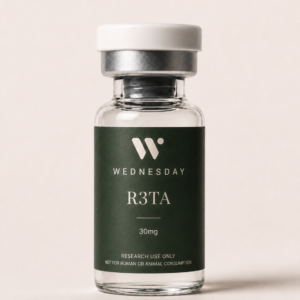 Metabolic Signaling Research
R3TA
30 mg, triple agonist for laboratory research View listing →
Metabolic Signaling Research
R3TA
30 mg, triple agonist for laboratory research View listing →
Frequently asked questions
What is the difference between GLP-1, GIP and glucagon?
All three are peptide hormones acting on related class B GPCRs. GLP-1 (from gut L-cells) lowers glucose and appetite; GIP (from gut K-cells) amplifies insulin secretion and, with chronic agonism, contributes to weight loss; glucagon (from pancreatic alpha cells) raises glucose but also increases energy expenditure and liver fat oxidation.
Why was GIP ignored as a drug target for so long?
Its insulin-stimulating effect is blunted in type 2 diabetes, and GIP receptor knockout mice resisted obesity, suggesting the hormone was obesogenic. Later rodent work showed that chronic agonism also reduced weight, and the dual agonist tirzepatide demonstrated the effect clinically.
Why include glucagon in a weight-loss peptide if it raises blood sugar?
Glucagon increases energy expenditure and reduces liver fat. When combined with GLP-1 and GIP activity, insulin secretion rises whenever glucose does, offsetting glucagon’s glucose-raising action while its thermogenic and hepatic effects are retained.
What is a multi-agonist peptide?
A single peptide engineered to activate two or more related receptors. Dual agonists such as tirzepatide activate GLP-1 and GIP receptors; triple agonists add the glucagon receptor. They share the lipidated, DPP-4-resistant design of GLP-1 analogues.
Is any triple agonist approved?
No. Triple GLP-1/GIP/glucagon agonists are in phase 3 trials. Research-grade triple agonists such as Wednesday’s R3TA are laboratory reagents and are not the investigational drugs studied in those trials.
References & further reading
- Müller TD, Finan B, Bloom SR, et al. Glucagon-like peptide 1 (GLP-1). Mol Metab. 2019;30:72–130. doi:10.1016/j.molmet.2019.09.010 / PMID 31767182
- Drucker DJ. Mechanisms of action and therapeutic application of glucagon-like peptide-1. Cell Metab. 2018;27(4):740–756. doi:10.1016/j.cmet.2018.03.001 / PMID 29617641
- Nauck MA, Heimesaat MM, Orskov C, et al. Preserved incretin activity of glucagon-like peptide 1 [7-36 amide] but not of synthetic human gastric inhibitory polypeptide in patients with type-2 diabetes mellitus. J Clin Invest. 1993;91(1):301–307. PMC330027
- Campbell JE. Targeting the GIPR for obesity: to agonize or antagonize? Potential mechanisms. Mol Metab. 2021;46:101139. doi:10.1016/j.molmet.2020.101139 / PMID 33290902
- Habegger KM, Heppner KM, Geary N, et al. The metabolic actions of glucagon revisited. Nat Rev Endocrinol. 2010;6(12):689–697. doi:10.1038/nrendo.2010.187 / PMID 20957001
- Finan B, Yang B, Ottaway N, et al. A rationally designed monomeric peptide triagonist corrects obesity and diabetes in rodents. Nat Med. 2015;21(1):27–36. doi:10.1038/nm.3761 / PMID 25485909
- Willard FS, Douros JD, Gabe MB, et al. Tirzepatide is an imbalanced and biased dual GIP and GLP-1 receptor agonist. JCI Insight. 2020;5(17):e140532. doi:10.1172/jci.insight.140532 / PMID 32730231
- Aronne LJ, Horn DB, le Roux CW, et al. Tirzepatide as compared with semaglutide for the treatment of obesity. N Engl J Med. 2025;393(1):26–36. doi:10.1056/NEJMoa2416394 / PMID 40353578
- Jastreboff AM, Kaplan LM, Frías JP, et al. N Engl J Med. 2023;389(6):514–526. doi:10.1056/NEJMoa2301972 / PMID 37366315