Key takeaways
- Triple agonists are single peptides engineered to activate the GLP-1, GIP and glucagon receptors, combining appetite suppression and insulin support with glucagon’s effect on energy expenditure.
- The concept was demonstrated in rodents in 2015 with a rationally designed monomeric triagonist that outperformed dual agonists on weight and glucose.
- A Lilly triple agonist in phase 2 reported mean weight reductions approaching a quarter of body weight at 48 weeks in obesity, along with large reductions in liver fat; phase 3 programs are ongoing.
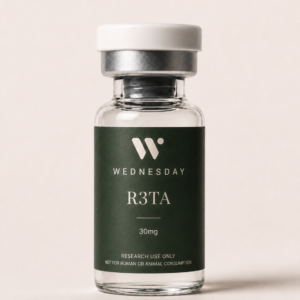
- No triple agonist is approved. Wednesday lists R3TA (30 mg), a triple GLP-1/GIP/glucagon receptor agonist under investigation, for laboratory research only.
The proglucagon gene encodes a family of hormones, glucagon, GLP-1, GLP-2, oxyntomodulin, that share sequence ancestry and act on structurally related receptors. For most of the history of incretin pharmacology, the goal was to activate one of those receptors, GLP-1, as selectively as possible. Over the past decade the goal inverted. Chemists found that a single peptide could be tuned to engage two or three family receptors at once, and that doing so produced effects on body weight and glucose that no single agonist had matched. Triple agonists that activate GLP-1, GIP and glucagon receptors are the furthest extension of that idea. This note reviews the rationale, the chemistry, the rodent proof of concept, the phase 2 human data reported for the class, and what has not yet been established.
Why three receptors
Each receptor contributes something the others do not. GLP-1 receptor activation reduces food intake through hypothalamic and brainstem circuits, slows gastric emptying and amplifies glucose-dependent insulin secretion.1 GIP receptor activation, long thought therapeutically useless, adds to weight loss when combined with GLP-1 in ways still being worked out, possibly through central appetite effects, adipose tissue actions and reduced nausea.2
Glucagon is the counterintuitive component. It is the hormone that raises blood glucose during fasting, and adding it to a diabetes drug seems perverse. But glucagon also increases energy expenditure, promotes hepatic fat oxidation, and reduces food intake, as Habegger and colleagues reviewed when they reappraised its metabolic actions.3 The design logic of a triple agonist is that the incretin components neutralize glucagon’s glucose-raising effect, by driving insulin secretion whenever glucose rises, while its thermogenic and hepatic effects are retained. The result, in principle, is weight loss driven by both reduced intake and increased expenditure, with a liver-directed action that neither GLP-1 nor GIP provides alone. The receptor biology is laid out in GLP-1 vs. GIP vs. Glucagon Receptors.
Proof of concept in rodents
The idea was made concrete in 2015. Finan, Tschöp, DiMarchi and colleagues reported a rationally designed monomeric peptide that activated all three receptors with balanced potency. In diet-induced obese mice, the triagonist reduced body weight and improved glucose tolerance more than a matched GLP-1/GIP dual agonist, and the glucagon component’s contribution was demonstrated by showing that the extra effect disappeared in glucagon receptor knockout animals.4 The paper established that a single peptide could carry three activities without one overwhelming the others, and that glucagon receptor agonism, in the presence of incretin activity, improved rather than worsened glycemic outcomes in rodents.
A triple agonist is a bet that the hormone which raises blood sugar can be made to lower body weight, provided two other hormones are there to catch the glucose.
How the molecules are built
Triple agonists use the same engineering toolkit as the single and dual agonists that preceded them: a peptide backbone drawn from the proglucagon family, substitutions at the N-terminus to resist DPP-4, further substitutions that tune affinity at each receptor, and a fatty diacid side chain that binds albumin to give a weekly duration. The difficulty is balance. A residue change that increases glucagon receptor potency may reduce GLP-1 receptor potency, and the ratio matters: too much glucagon activity relative to incretin activity risks hyperglycemia.
The clinical-stage Lilly compound, designated LY3437943 in its discovery publication, is a 39-amino-acid peptide with a C20 fatty diacid. Coskun and colleagues described its pharmacology in 2022: it is a full agonist at GIP and glucagon receptors and a less potent, partial agonist at the GLP-1 receptor, with a half-life supporting weekly dosing.5 The imbalance is deliberate, mirroring the GIP-weighted design of tirzepatide discussed in Semaglutide vs. Tirzepatide.
What phase 2 trials reported
The human data for the class come chiefly from the Lilly program. A phase 1b multiple-ascending-dose study in people with type 2 diabetes reported dose-dependent reductions in glucose and body weight over 12 weeks with a tolerability profile dominated by gastrointestinal effects.6
Two phase 2 trials followed in 2023. In the obesity trial, 338 adults with a body-mass index of 30 or more (or 27 with a weight-related condition) were randomized to the triple agonist at four dose levels or placebo for 48 weeks. Mean weight change at the highest dose was approximately −24% against about −2% on placebo, with weight still declining at study end.7 In the type 2 diabetes trial, 281 participants were randomized to the triple agonist, placebo or dulaglutide for 36 weeks; the highest doses reduced HbA1c by roughly two percentage points and body weight by up to about 17%, both exceeding the dulaglutide comparator.8 A phase 2a substudy in participants with metabolic dysfunction–associated steatotic liver disease reported relative reductions in liver fat exceeding 80% at the higher doses over 48 weeks, with most participants reaching normal liver fat content.9
Adverse effects were consistent with the incretin class, nausea, vomiting, diarrhea, constipation, and dose-dependent. Two signals specific to the glucagon component drew attention: modest increases in heart rate, more pronounced than with GLP-1 agonists alone, and cutaneous hyperesthesia or dysesthesia reported by a subset of participants at higher doses. Both are under evaluation in phase 3.
Phase 3 and the current picture
A phase 3 program in obesity, type 2 diabetes, knee osteoarthritis with obesity, and related conditions has been underway since 2023. Company announcements in late 2025 and 2026 described topline results from the first completed trials, reporting mean weight reductions in the high-twenties as a percentage of body weight over 68 weeks at the top dose, along with improvements in glycemic and pain endpoints in the relevant populations. As of this writing those results are available as press releases rather than peer-reviewed publications, and no triple agonist has been submitted to or approved by any regulator. The phase 3 data will determine whether the phase 2 magnitude holds in larger and more varied populations and how the heart-rate and sensory findings resolve.
Where the evidence sits
| Stage | Model or population | Principal observation | Status |
|---|---|---|---|
| Rodent proof of concept | Diet-induced obese mice4 | Triagonist superior to dual agonist on weight and glucose; glucagon component confirmed by knockout | Published 2015 |
| Discovery pharmacology | Receptor assays, rodents, phase 15 | Full GIP and glucagon agonism, partial GLP-1; weekly half-life | Published 2022 |
| Phase 1b | Type 2 diabetes, 12 weeks6 | Dose-dependent glucose and weight reduction | Published 2022 |
| Phase 2 | Obesity, 48 weeks7 | About −24% weight at top dose | Published 2023 |
| Phase 2 | Type 2 diabetes, 36 weeks8 | HbA1c about −2 points; weight up to −17% | Published 2023 |
| Phase 2a | Steatotic liver disease, 48 weeks9 | Liver fat reduced by more than 80% at higher doses | Published 2024 |
| Phase 3 | Multiple populations | Topline results announced; publications pending | Ongoing |
Reading the evidence
Every human result above describes an investigational pharmaceutical candidate in a monitored trial. It is not an approved drug, and research-grade triple agonist peptides are not that candidate. R3TA is sold as a laboratory reagent; no clinical finding applies to it.
What is not yet known
Several questions stand between the phase 2 data and a settled understanding of the class. How much of the effect is attributable to glucagon receptor activation in humans, as opposed to higher effective incretin engagement? Rodent knockout experiments answer this in mice; there is no equivalent human dissection. Does the glucagon component’s effect on energy expenditure persist, or does it attenuate as it does in some chronic glucagon studies? What happens to lean mass, given that glucagon promotes amino acid catabolism? Are the heart-rate and sensory findings benign? And, as with every weight-management peptide, what happens on discontinuation? These are the questions phase 3 and its extensions are designed to address.
R3TA in the research context
Wednesday’s catalog lists R3TA (30 mg), a triple GLP-1/GIP/glucagon receptor agonist for laboratory research. It is a synthetic peptide supplied lyophilized for in vitro and preclinical work, with identity and purity documented in the COA library. Legitimate research uses for a compound of this class include receptor pharmacology, potency and bias at each of the three receptors, signaling and trafficking studies in cell lines, and comparative pharmacokinetic and analytical method development for long lipidated peptides. It is not the investigational drug described in the trials above, and it is not for human use. The class background is in What Are GLP-1 Peptides?.
 Metabolic Signaling Research
R3TA
30 mg, triple agonist View listing →
Metabolic Signaling Research
R3TA
30 mg, triple agonist View listing →
Frequently asked questions
What is a triple agonist peptide?
A single synthetic peptide engineered to activate three proglucagon-family receptors: GLP-1, GIP and glucagon. GLP-1 and GIP components reduce appetite and support glucose-dependent insulin secretion; the glucagon component increases energy expenditure and hepatic fat oxidation. The combination is designed so the incretin activity offsets glucagon’s glucose-raising effect.
What did phase 2 trials of a triple agonist show?
In a 48-week obesity trial, the highest dose produced mean weight change of approximately −24% against about −2% on placebo. In a 36-week type 2 diabetes trial, HbA1c fell by roughly two percentage points and weight by up to about 17%. A liver substudy showed relative liver-fat reductions above 80%.
Is any triple agonist approved?
No. The most advanced candidate is in phase 3 trials, with topline results announced by the sponsor but not yet published in peer-reviewed form or submitted for regulatory approval as of this writing.
Why add glucagon to an obesity drug if it raises blood sugar?
Glucagon also raises energy expenditure and drives fat oxidation in the liver. When combined with GLP-1 and GIP activity, insulin secretion rises whenever glucose does, which in trials so far has offset the glucose-raising effect while retaining the thermogenic and hepatic benefits.
What is R3TA?
R3TA is Wednesday’s listing for a triple GLP-1/GIP/glucagon receptor agonist under investigation, supplied at 30 mg as a lyophilized peptide for laboratory research. It is a research reagent, not the investigational pharmaceutical studied in clinical trials, and not for human use.
References & further reading
- Drucker DJ. Mechanisms of action and therapeutic application of glucagon-like peptide-1. Cell Metab. 2018;27(4):740–756. doi:10.1016/j.cmet.2018.03.001 / PMID 29617641
- Campbell JE. Targeting the GIPR for obesity: to agonize or antagonize? Potential mechanisms. Mol Metab. 2021;46:101139. doi:10.1016/j.molmet.2020.101139 / PMID 33290902
- Habegger KM, Heppner KM, Geary N, et al. The metabolic actions of glucagon revisited. Nat Rev Endocrinol. 2010;6(12):689–697. doi:10.1038/nrendo.2010.187 / PMID 20957001
- Finan B, Yang B, Ottaway N, et al. A rationally designed monomeric peptide triagonist corrects obesity and diabetes in rodents. Nat Med. 2015;21(1):27–36. doi:10.1038/nm.3761 / PMID 25485909
- Coskun T, Urva S, Roell WC, et al. LY3437943, a novel triple glucagon, GIP, and GLP-1 receptor agonist for glycemic control and weight loss: from discovery to clinical proof of concept. Cell Metab. 2022;34(9):1234–1247. doi:10.1016/j.cmet.2022.07.013 / PMID 35985340
- Urva S, Coskun T, Loh MT, et al. LY3437943, a novel triple GIP, GLP-1, and glucagon receptor agonist in people with type 2 diabetes: a phase 1b, multicentre, double-blind, placebo-controlled, randomised, multiple-ascending dose trial. Lancet. 2022;400(10366):1869–1881. doi:10.1016/S0140-6736(22)02033-5 / PMID 36354040
- Jastreboff AM, Kaplan LM, Frías JP, et al. N Engl J Med. 2023;389(6):514–526. doi:10.1056/NEJMoa2301972 / PMID 37366315
- Rosenstock J, Frias J, Jastreboff AM, et al. Lancet. 2023;402(10401):529–544. doi:10.1016/S0140-6736(23)01053-X / PMID 37385280
- Sanyal AJ, Kaplan LM, Frias JP, et al. Nat Med. 2024;30(7):2037–2048. doi:10.1038/s41591-024-03018-2