Key takeaways
- At the American Diabetes Association’s 86th Scientific Sessions in New Orleans (June 5–8, 2026), Lilly’s triple GLP-1/GIP/glucagon receptor agonist reported its first phase 3 results, with weight reductions up to 28.3 percent at 80 weeks in obesity and HbA1c reductions near 2 percentage points in type 2 diabetes.
- Boehringer Ingelheim’s dual GLP-1/glucagon agonist survodutide, Novo Nordisk’s CagriSema combination and two oral agents, orforglipron and elecoglipron, also reported phase 2 or 3 data.
- Most of these trials were published simultaneously in The Lancet, The Lancet Diabetes & Endocrinology, JAMA or the New England Journal of Medicine, so primary data are available rather than press summaries.
- Research-grade multi-agonist peptides, including Wednesday’s R3TA, are not the pharmaceutical products studied in these trials, and the findings apply only to the trial populations and formulations.
The incretin field has moved so quickly that its conferences now function as publication events. ADA 2026 was the clearest example yet: within a single weekend in June, the first phase 3 results for a triple GLP-1/GIP/glucagon receptor agonist, two phase 3 programs for a dual GLP-1/glucagon agonist, three phase 3 trials of an amylin–GLP-1 combination and phase 2 or 3 data on two oral small-molecule GLP-1 agonists were presented, most of them with same-day journal publication. For researchers who study the receptor biology behind these compounds, the meeting is a rare chance to see multi-agonism, single agonism and oral delivery reported side by side. This note summarizes the readouts with their primary citations and situates them for readers of Wednesday’s triple-agonist research overview. It does not discuss dosing and it makes no claims about research-grade material, which is not what these trials tested.
The triple agonist: TRIUMPH-1 and TRANSCEND-T2D-1
The headline data belonged to Lilly’s once-weekly triple agonist of the GIP, GLP-1 and glucagon receptors. Two phase 3 trials were presented on June 6.
TRIUMPH-1 enrolled 2,339 adults with obesity without diabetes and followed them for 80 weeks. Weight reductions ranged from 19.0 to 28.3 percent across doses, against 2.2 percent with placebo; nearly all treated participants lost at least 5 percent of body weight. In an extension to 104 weeks, the highest dose group approached 30 percent. Sub-studies in participants with obstructive sleep apnea reported reductions in the apnea–hypopnea index of up to 60 percent, and participants with knee osteoarthritis reported pain reductions of up to 70 percent on the study scale.1,2 Adverse events were dominated by gastrointestinal effects during dose escalation, consistent with the class; the investigators reported no new safety signals apart from an increase in urinary tract infections that had not been prominent in earlier trials.1
TRANSCEND-T2D-1 enrolled 537 adults with type 2 diabetes for 40 weeks. HbA1c fell by 18.5 to 21.2 mmol/mol (roughly 1.7 to 1.9 percentage points) versus 8.9 mmol/mol with placebo, and body weight by 11.5 to 15.3 percent versus 2.6 percent. Eighty-five percent of treated participants reached an HbA1c of 6.5 percent or below and 46 percent reached below 5.7 percent, the non-diabetic range. No hypoglycemia was reported.1,2 The trial was published in The Lancet the same week by Bajaj and colleagues.3
For context: the 2023 phase 2 trial of the same molecule had reported roughly 24 percent weight reduction at 48 weeks, so the phase 3 result is consistent with, and extends, the earlier signal. The significance of the glucagon component, which raises energy expenditure and hepatic fat oxidation while GLP-1 and GIP suppress appetite and improve insulin secretion, is discussed in Wednesday’s note on why multi-agonism emerged.
Survodutide: the dual GLP-1/glucagon agonist
Boehringer Ingelheim’s survodutide, which lacks the GIP component, reported two phase 3 programs. SYNCHRONIZE-1 (725 participants with obesity, 76 weeks) showed weight loss of 12.2 to 13.0 percent versus 5.4 percent with placebo, with an MRI sub-study reporting 27.8 to 63.1 percent reductions across fat compartments. SYNCHRONIZE-MASLD (216 participants with metabolic dysfunction-associated steatotic liver disease) reported that 68.5 percent of treated participants achieved at least a 30 percent reduction in liver fat versus 28.6 percent on placebo, with a 58.7 percent mean liver-fat reduction versus 9.5 percent.2 SYNCHRONIZE-1 was published in the New England Journal of Medicine by le Roux and colleagues.4 Discontinuation for gastrointestinal effects was notable in the obesity trial.
The comparison with the triple agonist is instructive for receptor pharmacology. Survodutide’s liver-fat effect is the glucagon signature; its smaller total weight effect, relative to the triple agonist, is consistent with the absence of GIP agonism, though cross-trial comparison is indirect.
CagriSema: amylin plus GLP-1
Novo Nordisk’s fixed-dose combination of the amylin analogue cagrilintide and semaglutide reported three phase 3 trials in type 2 diabetes under the REIMAGINE program. REIMAGINE 1 (189 participants, 40 weeks, early diabetes) reduced HbA1c by 16.4 to 19.7 mmol/mol versus 1.1 mmol/mol with placebo, with 11.8 to 13.8 percent weight loss. REIMAGINE 2 (2,728 participants, 68 weeks) showed the combination lowered HbA1c 1.7 mmol/mol more than semaglutide alone. REIMAGINE 3 (274 participants on basal insulin, 40 weeks) reduced HbA1c by 23.0 to 25.5 mmol/mol versus 7.2 with placebo.2 REIMAGINE 2 appeared in The Lancet Diabetes & Endocrinology.5 This is a different strategy from multi-agonism at a single receptor family: amylin acts on distinct receptors in the hindbrain, and the combination tests whether two separate satiety systems add.
The oral agents
Two non-peptide oral GLP-1 receptor agonists reported data. Lilly’s orforglipron presented three phase 3 ACHIEVE trials in type 2 diabetes, comparing favorably with dapagliflozin (ACHIEVE-2), oral semaglutide (ACHIEVE-3) and placebo on background insulin (ACHIEVE-5), with HbA1c reductions of roughly 13 to 21 mmol/mol depending on trial and dose.2 AstraZeneca’s elecoglipron reported phase 2b results: a 20.8 mmol/mol HbA1c reduction at its highest dose in SOLSTICE, published in The Lancet by Aroda and colleagues,6 and 2.6 to 10.5 percent weight loss over 26 weeks in VISTA.2 Pfizer’s ultra-long-acting injectable GLP-1 agonist berobenatide also reported phase 2b data, with placebo-adjusted weight loss of up to 12.3 percent at 28 weeks on a monthly schedule.2,7
These molecules are chemically unrelated to peptides, they are small molecules that bind the GLP-1 receptor, and none is a research peptide. They matter to peptide researchers as a benchmark: single-receptor oral agonism reaches roughly 10 percent weight loss in these trials, against the 20 to 28 percent reported for injectable multi-agonist peptides.
| Program | Mechanism | Phase / population | Key result at ADA 2026 | Primary publication |
|---|---|---|---|---|
| TRIUMPH-1 | Triple GIP/GLP-1/glucagon agonist | Phase 3, obesity, n=2,339, 80 wk | −19.0 to −28.3% weight vs −2.2% | Presented; publication not located |
| TRANSCEND-T2D-1 | Triple GIP/GLP-1/glucagon agonist | Phase 3, T2D, n=537, 40 wk | HbA1c −18.5 to −21.2 mmol/mol vs −8.9 | Lancet 2026;407:24023 |
| SYNCHRONIZE-1 | Dual GLP-1/glucagon agonist | Phase 3, obesity, n=725, 76 wk | −12.2 to −13.0% weight vs −5.4% | NEJM 20264 |
| SYNCHRONIZE-MASLD | Dual GLP-1/glucagon agonist | Phase 3, MASLD, n=216, 48 wk | 68.5% vs 28.6% achieved ≥30% liver-fat reduction | Presented |
| REIMAGINE 1–3 | Amylin analogue + GLP-1 RA | Phase 3, T2D | HbA1c −16 to −26 mmol/mol by trial | Lancet Diabetes Endocrinol; Lancet5 |
| ACHIEVE-2/3/5 | Oral small-molecule GLP-1 RA | Phase 3, T2D | HbA1c −13 to −21 mmol/mol | Lancet; JAMA2 |
| SOLSTICE / VISTA | Oral small-molecule GLP-1 RA | Phase 2b, T2D / obesity | HbA1c −20.8 mmol/mol; −10.5% weight | Lancet6 |
The meeting’s real finding was structural: adding receptors adds effect, and the field now has phase 3 data at one, two and three receptors to prove it.
What the data do and do not establish
Three cautions apply. First, these are pharmaceutical products manufactured under GMP, administered in supervised trials to selected populations with defined exclusion criteria. The results describe those products in those people. Second, cross-trial comparisons, triple versus dual versus oral, are indirect; populations, durations and endpoints differ, and only head-to-head trials can rank compounds. Third, the safety picture is still forming. The urinary tract infection signal in TRIUMPH-1 and the gastrointestinal discontinuation rates in the survodutide program are the kind of findings that become clearer with regulatory review and post-marketing data.
None of the compounds discussed here has been approved for obesity or diabetes on the basis of these data as of early September 2026, and the triple agonist’s regulatory submission timeline has not been the subject of a primary-source announcement Wednesday could verify.
Reading the evidence
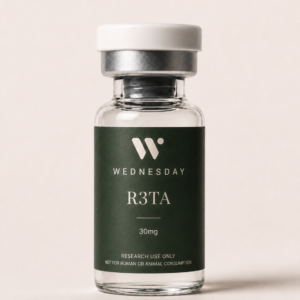
Wednesday’s R3TA is a research-grade triple GLP-1/GIP/glucagon receptor agonist supplied for laboratory use only. It is not the pharmaceutical product tested in TRIUMPH or TRANSCEND, has not been through any clinical trial, and no result reported above applies to it. The trials are cited because they define the receptor biology that makes the compound class a subject of research.
What comes next
The next scheduled venue for incretin data is the 62nd EASD Annual Meeting in Milan, September 28 to October 2, 2026, where additional TRIUMPH and SYNCHRONIZE analyses and further oral-agent data are expected.8 The regulatory story is moving in parallel: FDA’s 2026 actions on compounded GLP-1 products, discussed in a separate note, and its August warning letters to research-labeled sellers of GLP-1-class peptides show the agency treating multi-agonists as drugs regardless of how they are labeled. For the receptor biology behind all of this, start with what GLP-1 peptides are.
 Metabolic Signaling Research
R3TA
Triple GLP-1/GIP/glucagon receptor agonist, research use only, third-party tested View listing →
Metabolic Signaling Research
R3TA
Triple GLP-1/GIP/glucagon receptor agonist, research use only, third-party tested View listing →
Frequently asked questions
What were the triple agonist phase 3 results at ADA 2026?
TRIUMPH-1 reported 19.0 to 28.3 percent weight reduction at 80 weeks in 2,339 adults with obesity, versus 2.2 percent on placebo. TRANSCEND-T2D-1 reported HbA1c reductions of about 1.7 to 1.9 percentage points in 537 adults with type 2 diabetes, with 11.5 to 15.3 percent weight loss. Both were presented June 6, 2026; TRANSCEND-T2D-1 was published in The Lancet.
Is the triple GLP-1/GIP/glucagon agonist FDA approved?
No. As of September 2026 it remains an investigational drug. The ADA 2026 data are from phase 3 trials, which typically precede a regulatory submission; no approval has been announced.
What is the difference between a dual and a triple agonist?
A dual agonist such as survodutide activates GLP-1 and glucagon receptors; tirzepatide activates GLP-1 and GIP. A triple agonist activates all three. Each receptor contributes a different effect, appetite suppression, insulin secretion, energy expenditure and hepatic fat oxidation, and the ADA 2026 trials show larger effects with more receptors, though only indirect comparison is possible.
Is research-grade R3TA the same as the drug in the TRIUMPH trials?
No. R3TA is a research chemical supplied for laboratory use. It is not the GMP-manufactured pharmaceutical product tested in any clinical trial, and no trial result applies to it. It is not intended for human use.
Where were the ADA 2026 incretin trials published?
TRANSCEND-T2D-1 in The Lancet; SYNCHRONIZE-1 in the New England Journal of Medicine; REIMAGINE 1 and 2 in The Lancet Diabetes & Endocrinology and REIMAGINE 3 in The Lancet; the ACHIEVE trials in The Lancet and JAMA; SOLSTICE and VISTA in The Lancet. DOIs are in the references.
References & further reading
- ADA Meeting News. Triple-hormone therapy demonstrates efficacy for type 2 diabetes and obesity. June 8, 2026. adameetingnews.org
- Diabetes on the Net. ADA 2026 highlights: therapies in development for type 2 diabetes, obesity, dyslipidaemia and liver disease. July 7, 2026. diabetesonthenet.com
- Bajaj HS, Welch M, Shah P, Luna E, Jaouimaa FZ, Liu B, Liu R, Chen Y, Patel H, Bartee A. Lancet. 2026;407(10546):2402–2413. doi:10.1016/S0140-6736(26)00967-0
- le Roux CW, Wharton S, Startseva E, et al. Survodutide Once Weekly for the Treatment of Adults with Obesity. N Engl J Med. 2026. doi:10.1056/NEJMoa2600751
- Buse JB, Bajaj HS, Dalskov SM, et al. Cagrilintide–semaglutide (CagriSema) versus semaglutide or cagrilintide in people with type 2 diabetes (REIMAGINE 2): a double-blind, randomised, controlled, phase 3 study. Lancet Diabetes Endocrinol. 2026. doi:10.1016/S2213-8587(26)00125-7
- Aroda VR, Davies MJ, Maaske J, et al. Elecoglipron, an oral small molecule GLP-1 receptor agonist in adults with type 2 diabetes (SOLSTICE): a multicentre, phase 2b, randomised, placebo-controlled trial. Lancet. 2026. doi:10.1016/S0140-6736(26)00802-0
- HCPLive. ADA 2026 Recap: 5 Key Presentations to Know. June 11, 2026. hcplive.com
- European Association for the Study of Diabetes. 62nd EASD Annual Meeting, Milan, 28 September–2 October 2026. easd.org
- Jastreboff AM, Kaplan LM, Frías JP, et al. N Engl J Med. 2023;389(6):514–526. doi:10.1056/NEJMoa2301972 (phase 2 trial of the triple agonist in obesity)