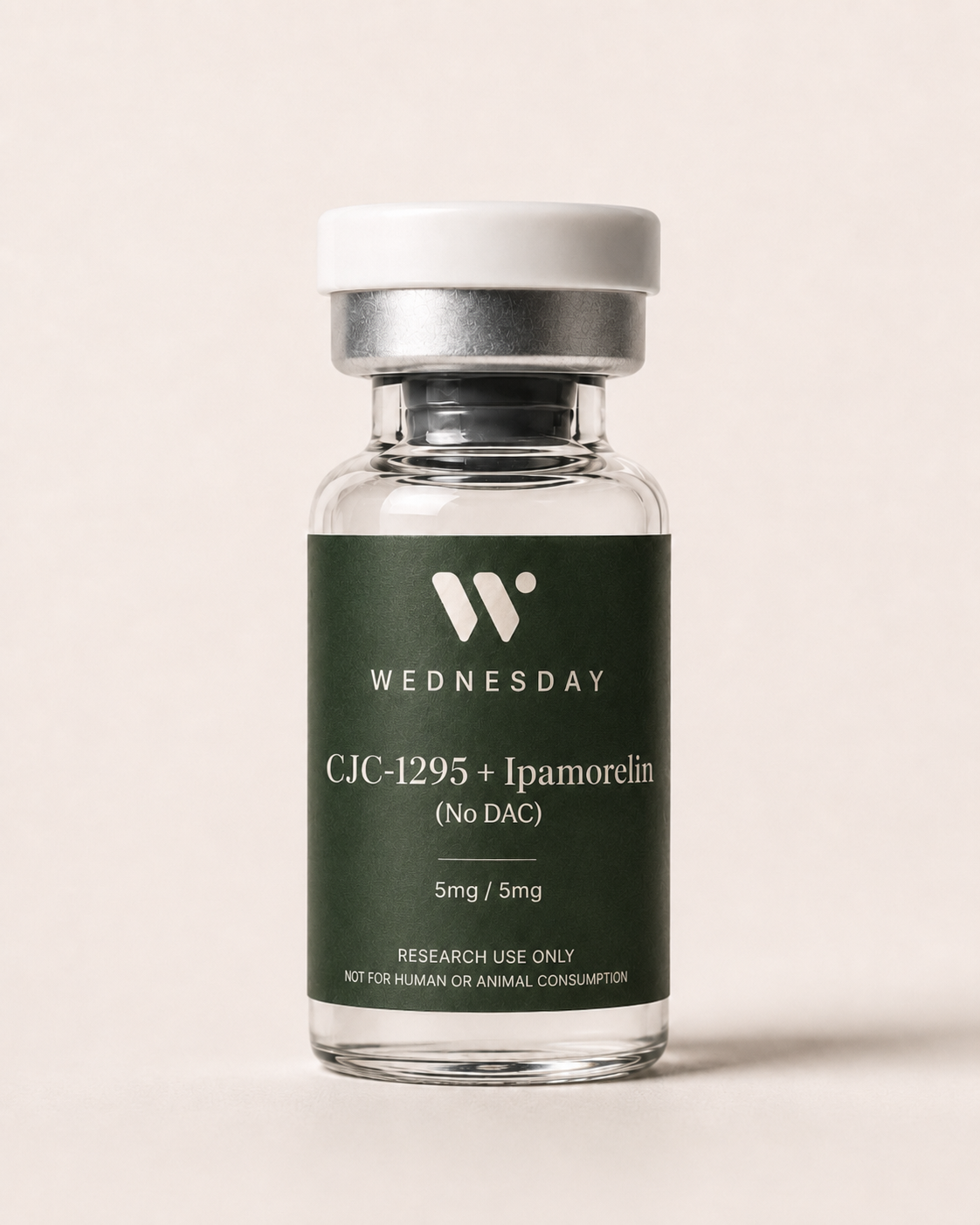
CJC-1295 + Ipamorelin
Current listing
CJC-1295 + Ipamorelin - 5mg / 5mg blend listing for GH-axis signaling research.
Add to cart
Select quantity and add this listing to your order.
Research-use listing. For qualified laboratory research use only. No product-use instructions are provided.
In stock
Need BAC Water?
BAC Water is available for applicable laboratory orders and can also be ordered on its own.
Overview
CJC-1295 is a synthetic GHRH analog engineered for extended GHRH receptor activation in endocrine research. The listed CJC-1295 + Ipamorelin blend is framed around dual-pathway GH-axis signaling studies.
Ipamorelin is generally discussed as a selective ghrelin-receptor research compound, making the blend relevant for studies comparing GHRH-mediated and ghrelin-receptor-mediated signaling in controlled models.
Potential research applications
- Extended GHRH receptor activation and sustained GH-release modeling
- GHRH receptor and ghrelin-receptor signaling interaction studies
- IGF-1 axis amplification and systemic growth-factor cascade research
- Peptide-stability, DPP-IV resistance, and secretagogue-selectivity studies
- Neuroendocrine feedback, sleep-pattern, and metabolic-signaling models
Research-use limits
For qualified laboratory research use only. This page does not provide protocols, product-use instructions, clinical guidance, outcome claims, or internal sourcing and batch details.
Order notes
Catalog listings can be added with quantity selection.
From the research library
Sermorelin: A Review of GHRH-Analogue Research
Sermorelin is the first 29 amino acids of human GHRH. What the pediatric, aging and mechanistic literature actually recorded, and where the evidence stops.
What Is HPLC and How Does It Measure Peptide Purity?
HPLC separates a peptide from its impurities on a column and reports the result as a chromatogram. Here is how it works and how to read one on a COA.
CJC-1295 and Ipamorelin: Why Researchers Study Them Together
A GHRH analog and a ghrelin-receptor agonist act on two different pituitary receptors. The literature explains why that pairing draws research interest.