Key takeaways
- CJC-1295 is a modified fragment of growth-hormone-releasing hormone, and ipamorelin is a synthetic agonist of the ghrelin receptor, so the two compounds act on different pituitary receptors.
- “CJC-1295” is used for two different molecules: the albumin-binding version with a Drug Affinity Complex (DAC) that circulates for days, and the short-acting version without it, often called modified GRF(1-29).
- The rationale for pairing a GHRH analog with a ghrelin mimetic comes from 1990s endocrinology showing the two receptor classes release GH synergistically, not from trials of this specific blend.
- Neither compound is an approved drug; both went through early clinical development that stopped, and no controlled study of the CJC-1295 and ipamorelin combination has been published.
Few peptide pairings appear in research catalogs as often as CJC-1295 with ipamorelin, and few are as routinely misdescribed. The two are not variants of the same thing. One is a re-engineered piece of the hypothalamic hormone that tells the pituitary to release growth hormone; the other mimics a stomach-derived hormone that acts on a separate receptor in the same cells. That distinction is the whole point. Researchers interested in the growth-hormone axis study the pair because the axis has two upstream inputs, and a model that stimulates both is a different experiment from one that stimulates either alone. This note lays out what the primary literature actually documents for each compound, why the combination has a mechanistic rationale, and where the evidence stops.
Two receptors, one pituitary cell
Growth hormone is released from somatotroph cells in the anterior pituitary in pulses. Two hypothalamic signals set the rhythm: growth-hormone-releasing hormone (GHRH) drives release, and somatostatin restrains it. A third input was identified in 1999 when Kojima and colleagues isolated ghrelin from rat stomach and showed it stimulated GH release through a receptor that had been cloned three years earlier as an “orphan”, the growth-hormone secretagogue receptor, GHS-R1a.1
The two receptors use different intracellular wiring. The GHRH receptor couples to a stimulatory G protein and raises cyclic AMP. GHS-R1a couples to a different G protein, activates phospholipase C, and raises intracellular calcium via inositol trisphosphate. Because the pathways converge on the same secretory machinery from different directions, activating both can produce more GH release than either alone. That was demonstrated in humans before ghrelin itself was discovered: in 1990, Bowers and colleagues reported that a synthetic GH-releasing peptide given together with GHRH produced a GH response in healthy men that was greater than the sum of the two given separately.2 Nearly every later argument for combining a GHRH analog with a ghrelin mimetic traces back to that observation. For a fuller map of the axis, see GH vs. GHRH vs. GHRP.
CJC-1295: what the molecule is
Native GHRH is a 44-amino-acid peptide, but the first 29 residues carry full receptor activity. GRF(1-29), the basis of sermorelin, has a plasma half-life of minutes because an enzyme, dipeptidyl peptidase IV, clips the second residue and other proteases finish the job. In 2005, a group at the Montreal biotechnology company ConjuChem published the design of a GRF(1-29) analog with four amino-acid substitutions (D-alanine at position 2, glutamine at 8, alanine at 15, leucine at 27) chosen to block those cleavage sites.3 The substitutions alone extend stability, but the defining feature of CJC-1295 is what was attached at the C-terminal end.
With DAC
The Drug Affinity Complex is a reactive chemical group, a maleimidopropionic acid linked through a lysine, that forms a covalent bond with a specific cysteine (Cys34) on circulating albumin. Once bound, the peptide shares albumin’s long residence in the bloodstream. Jetté and colleagues showed in rats that the albumin conjugate still activated the GHRH receptor on the anterior pituitary and produced a sustained rise in GH and IGF-1 rather than a brief spike.3 In healthy human volunteers studied by Teichman and colleagues in a dose-escalation trial, single injections raised mean GH concentrations two- to tenfold for six days or more and raised IGF-1 for nine to eleven days; the estimated half-life was between five and eight days.4
Without DAC
The same tetrasubstituted 29-residue peptide without the albumin-binding group is what catalogs label “CJC-1295 without DAC” or “modified GRF(1-29).” It has the protease-resistant substitutions but not the albumin anchor, so its pharmacokinetics resemble a stabilized short-acting GHRH fragment measured in tens of minutes rather than days. The ConjuChem clinical papers concern the DAC conjugate only; the non-DAC version was an intermediate in that design work and has no comparable published human data. When a study or a product refers to “CJC-1295,” the first question a reader should ask is which of the two molecules is meant, because the answer changes the expected time course by roughly two orders of magnitude.
| Feature | CJC-1295 with DAC | CJC-1295 without DAC (mod GRF 1-29) | Ipamorelin |
|---|---|---|---|
| Target receptor | GHRH receptor | GHRH receptor | Ghrelin receptor (GHS-R1a) |
| Structure | 29 aa, 4 substitutions, albumin-binding linker | 29 aa, 4 substitutions | 5 aa, non-natural residues, C-terminal amide |
| Reported half-life | ~5–8 days in humans4 | Minutes (no dedicated human PK study) | ~2 hours in humans6 |
| Human data | Phase 1/2 (ConjuChem, discontinued) | None specific to this form | Phase 1 PK; Phase 2 in postoperative ileus (negative) |
| Originator | ConjuChem | , | Novo Nordisk |
Pulsatility: the finding that mattered most
A reasonable worry about a GHRH analog that persists for a week is that constant stimulation would flatten the pulsatile GH rhythm into a plateau, which is not how the axis normally operates. Ionescu and Frohman tested this directly by sampling blood every twenty minutes for twenty-four hours in healthy adults before and after CJC-1295 administration. GH pulses persisted. What changed was the baseline: trough GH levels between pulses rose, pulse amplitude increased, and total GH secretion went up, but pulse frequency did not.5 Their interpretation was that the analog raises the “floor” of the system while the somatostatin rhythm continues to shape the peaks.
The clinical program did not continue. ConjuChem was developing CJC-1295 for HIV-associated lipodystrophy and growth-hormone deficiency; in 2006 a participant in a Phase 2 study died, and although the attending physician attributed the death to pre-existing coronary artery disease, development stopped. No later sponsor has published human trials, and the compound remains unapproved anywhere.
A long-acting GHRH analog that preserved pulsatility was the interesting result; the absence of any trial since 2006 is the equally important one.
Ipamorelin: a selective ghrelin mimetic
Ipamorelin was designed at Novo Nordisk in the 1990s as a pentapeptide (Aib-His-D-2-Nal-D-Phe-Lys-NH2) derived from the earlier GH-releasing peptide GHRP-1. Raun and colleagues described it in 1998 as “the first selective growth hormone secretagogue.”7 The claim of selectivity rested on comparisons with GHRP-6 and GHRP-2: in rat pituitary cell cultures and in anesthetized rats and swine, ipamorelin released GH with a potency and efficacy comparable to GHRP-6, but at GH-releasing doses it did not produce the rise in ACTH and cortisol seen with the older peptides, and it did not release prolactin. In human volunteers, Gobburu and colleagues fit a pharmacokinetic–pharmacodynamic model to intravenous ipamorelin and reported an elimination half-life of about two hours with a dose-dependent GH response.6
Because ghrelin receptors are also present in the gut, ipamorelin was later licensed to Helsinn and taken into a Phase 2 trial for postoperative ileus after bowel resection. In that randomized, placebo-controlled study of 114 patients, the primary endpoint, time to first tolerated meal, did not differ significantly between ipamorelin and placebo, and the program was not advanced.8 The trial matters here for two reasons: it is the largest controlled human dataset on the compound, and it was not a GH-axis study. A separate note, Ipamorelin: A Review of Selective GH-Secretagogue Research, covers the compound in more depth.
Why the pairing draws research interest
Put the pieces together and the logic of studying the two compounds side by side becomes clear. A GHRH analog raises the baseline drive on somatotrophs through cyclic AMP. A ghrelin mimetic acts on the same cells through calcium signaling and, as Bowers showed, the combination of the two receptor classes is more than additive in humans.2 Ipamorelin’s selectivity, no cortisol or prolactin release at effective doses in animal models, makes it the ghrelin-side compound least likely to confound a GH readout with stress-hormone effects. And because the two peptides have very different half-lives, an experimenter can vary the timing relationship between a slow GHRH signal and a fast ghrelin signal, which is precisely the kind of question a two-receptor model exists to ask.
What the literature does not contain is a published controlled study of CJC-1295 together with ipamorelin, in animals or in humans. The synergy evidence comes from GHRH plus GHRP-6 or GHRP-2 in the early 1990s; the pulsatility evidence comes from CJC-1295 alone; the selectivity evidence comes from ipamorelin alone. Any statement about what the combination “does” is an inference across those separate bodies of work, and should be described that way. Combined preparations also raise the analytical questions covered in Peptide Blends in Research: a two-component vial requires two identity confirmations and two quantitations on the certificate of analysis, and a single purity figure is not sufficient to characterize it.
Reading the evidence
Both compounds are research chemicals, not approved drugs. The human data on CJC-1295 come from small early-phase studies published in 2006 by the originating company; the human data on ipamorelin are a Phase 1 pharmacokinetic study and a negative Phase 2 trial in a gastrointestinal indication. Neither dataset supports claims about effects in people using research-grade material, and neither was designed to. Regulatory status in the United States has shifted repeatedly as FDA has reviewed bulk substances nominated for compounding, and readers should consult the agency’s current lists directly.9
Analytical notes for the two-component vial
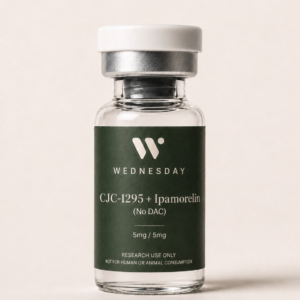
Because the pairing is sold as a blend, characterization deserves a word. CJC-1295 with DAC has a molecular weight near 3,647 Da; the non-DAC peptide is about 3,368 Da; ipamorelin is 711.9 Da. Those masses are far enough apart that mass spectrometry can confirm which GHRH analog is present and whether the ghrelin mimetic is there at all. HPLC purity should be reported for each component, since a chromatogram of a mixture shows two principal peaks and a single “purity” percentage can hide a poorly balanced ratio. Anti-doping laboratories have published methods for identifying CJC-1295 in seized preparations precisely because the label and the contents did not always agree.10 Wednesday’s COA library reports identity and purity per component for blended listings, and the catalog guide explains how to read a two-peak chromatogram.
 GH-Axis Research
CJC-1295 + Ipamorelin
5 mg / 5 mg blend View listing →
GH-Axis Research
CJC-1295 + Ipamorelin
5 mg / 5 mg blend View listing →
Frequently asked questions
What is the difference between CJC-1295 with DAC and without DAC?
Both are the same 29-amino-acid GHRH fragment with four stabilizing substitutions. The DAC version carries an additional chemical group that binds covalently to albumin in the blood, extending its half-life to roughly a week in the published human study. The version without DAC lacks that anchor and clears in minutes; it is often labeled modified GRF(1-29).
Is ipamorelin a growth hormone?
No. Ipamorelin is a five-amino-acid synthetic peptide that binds the ghrelin receptor on pituitary cells and causes them to release the body’s own growth hormone in animal and human studies. It contains no growth hormone and is structurally unrelated to it.
Why are CJC-1295 and ipamorelin studied together?
They act on two different receptors on the same pituitary cells. Human studies from 1990 showed that stimulating the GHRH receptor and the ghrelin receptor simultaneously releases more GH than either alone. Researchers use the pair to model that two-input control of the axis, although no published trial has tested this exact combination.
Has CJC-1295 been tested in humans?
Yes, in small Phase 1 and Phase 2 studies run by ConjuChem and published in 2006, which reported sustained GH and IGF-1 elevation with preserved pulsatile secretion. Development stopped after a participant death in a Phase 2 trial, and no human trials have been published since. It is not an approved drug.
Is CJC-1295 ipamorelin FDA approved?
No. Neither compound is approved for any use in any country. Both have been reviewed by FDA in the context of its bulk-drug-substance lists for compounding, and that regulatory status has changed over time. Material sold for research is not a pharmaceutical product.
References & further reading
- Kojima M, Hosoda H, Date Y, Nakazato M, Matsuo H, Kangawa K. Ghrelin is a growth-hormone-releasing acylated peptide from stomach. Nature. 1999;402(6762):656–660. doi:10.1038/45230 / PMID 10604470
- Bowers CY, Reynolds GA, Durham D, Barrera CM, Pezzoli SS, Thorner MO. Growth hormone (GH)-releasing peptide stimulates GH release in normal men and acts synergistically with GH-releasing hormone. J Clin Endocrinol Metab. 1990;70(4):975–982. doi:10.1210/jcem-70-4-975
- Jetté L, Léger R, Thibaudeau K, et al. Human growth hormone-releasing factor (hGRF)1-29-albumin bioconjugates activate the GRF receptor on the anterior pituitary in rats: identification of CJC-1295 as a long-lasting GRF analog. Endocrinology. 2005;146(7):3052–3058. doi:10.1210/en.2004-1286 / PMID 15817669
- Teichman SL, Neale A, Lawrence B, Gagnon C, Castaigne JP, Frohman LA. Prolonged stimulation of growth hormone (GH) and insulin-like growth factor I secretion by CJC-1295, a long-acting analog of GH-releasing hormone, in healthy adults. J Clin Endocrinol Metab. 2006;91(3):799–805. doi:10.1210/jc.2005-1536 / PMID 16352683
- Ionescu M, Frohman LA. Pulsatile secretion of growth hormone (GH) persists during continuous stimulation by CJC-1295, a long-acting GH-releasing hormone analog. J Clin Endocrinol Metab. 2006;91(12):4792–4797. doi:10.1210/jc.2006-1702 / PMID 17018654
- Gobburu JV, Agersø H, Jusko WJ, Ynddal L. Pharmacokinetic-pharmacodynamic modeling of ipamorelin, a growth hormone releasing peptide, in human volunteers. Pharm Res. 1999;16(9):1412–1416. doi:10.1023/A:1018955126402 / PMID 10496658
- Raun K, Hansen BS, Johansen NL, et al. Ipamorelin, the first selective growth hormone secretagogue. Eur J Endocrinol. 1998;139(5):552–561. doi:10.1530/eje.0.1390552 / PMID 9849822
- Beck DE, Sweeney WB, McCarter MD; Ipamorelin 201 Study Group. Prospective, randomized, controlled, proof-of-concept study of the Ghrelin mimetic ipamorelin for the management of postoperative ileus in bowel resection patients. Int J Colorectal Dis. 2014;29(12):1527–1534. doi:10.1007/s00384-014-2030-8 / PMID 25331030
- U.S. Food and Drug Administration. Certain bulk drug substances for use in compounding that may present significant safety risks. fda.gov
- Henninge J, Pepaj M, Hullstein I, Hemmersbach P. Identification of CJC-1295, a growth-hormone-releasing peptide, in an unknown pharmaceutical preparation. Drug Test Anal. 2010;2(11–12):647–650. doi:10.1002/dta.233 / PMID 21204297