Key takeaways
- NMN and NR are two steps and one step, respectively, from NAD+ in the salvage pathway; NAD+ is the finished coenzyme.
- Tracer studies show both oral precursors are largely converted to nicotinamide in the gut and liver, and that gut bacteria also turn them into nicotinic acid, before rebuilding NAD+ in tissue.
- In head-to-head human data, NR and NMN raised circulating NAD+ to a similar degree; direct NAD+ has only small intravenous pharmacokinetic studies.
- FDA excluded NMN from the dietary-supplement definition in 2022, then reversed that position in September 2025; NR has held new-dietary-ingredient status since 2016.
Three molecules dominate the NAD+ literature, and they are routinely confused. Nicotinamide mononucleotide (NMN) and nicotinamide riboside (NR) are precursors: the cell converts them into NAD+. NAD+ itself is the finished coenzyme. Each has a different size, a different route into the cell, a different body of human evidence, and, in the United States, a different regulatory history. The differences matter to anyone reading a study, because a result obtained with one molecule is often reported as if it applied to all three. This note lays the comparison out and points to the primary sources. For background on what NAD+ does, see What Is NAD+?
Three points on one pathway
The salvage pathway recycles nicotinamide, the vitamin B3 fragment released whenever sirtuins, PARPs or CD38 consume NAD+. The enzyme NAMPT attaches a phosphoribose group to nicotinamide to make NMN, and NMNAT enzymes then add adenosine monophosphate to make NAD+. NR enters this pathway from the side: nicotinamide riboside kinases (NRK1 and NRK2) phosphorylate NR to NMN, which proceeds to NAD+ as before.1
The structural differences are simple. NR is nicotinamide joined to a ribose sugar. NMN is NR with a phosphate group added; that phosphate makes it larger and negatively charged, which affects how it crosses membranes. NAD+ is NMN joined through its phosphate to adenosine monophosphate, making it a dinucleotide roughly twice the size of NMN and carrying charge at physiological pH.1
How each gets into cells
Because cells need NAD+ inside them, uptake is the central question. Ratajczak and colleagues showed in 2016 that NRK1 is rate-limiting for the use of both NR and NMN by mammalian cells, and that extracellular NMN must first be dephosphorylated to NR before entering; cells lacking NRK1 could not build NAD+ from either compound.2 This argued that NMN acts largely as a delivery form of NR. In 2019, Grozio and colleagues reported that the transporter Slc12a8 imports NMN directly into cells, particularly in the small intestine, and that its expression rises with age.3 The two findings have not been fully reconciled, and the relative contribution of direct NMN import versus conversion to NR remains debated.
Whole-body tracing complicates the picture further. Liu and colleagues used isotope-labeled precursors in mice and found that after oral dosing, most NR and NMN was broken down to nicotinamide in the intestine and liver; the labeled NAD+ that appeared in peripheral tissues had been rebuilt from nicotinamide, not delivered intact.4 In 2025, Yaku and colleagues added an unexpected route: in mice, both precursors, even when given intravenously, were secreted into bile, converted by gut bacteria to nicotinic acid, and reabsorbed to make NAD+ in the liver. Antibiotic-treated mice built less NAD+ from either compound.5
NAD+ itself is the least membrane-permeable of the three. Whether intact NAD+ enters mammalian cells to a meaningful degree, or is first broken down outside the cell by enzymes such as CD73 to NMN and NR, is unresolved.1
By the time any of these molecules reaches a muscle cell, it has usually been taken apart and rebuilt; the label on the vial describes the starting point, not the arrival.
Human evidence, molecule by molecule
Nicotinamide riboside
NR has the largest human trial record. First-in-human work in 2016 established oral bioavailability and identified nicotinic acid adenine dinucleotide (NAAD) as a blood biomarker of NR exposure.1 Martens and colleagues found that six weeks of NR raised blood-cell NAD+ by about 60 percent in 24 middle-aged and older adults and was well tolerated.6 An eight-week randomized trial in 140 overweight adults reported dose-dependent NAD+ increases with no safety signals. Functional endpoints across NR trials, including muscle mitochondrial function, insulin sensitivity and blood pressure, have mostly been null or marginal.
Nicotinamide mononucleotide
NMN’s human data are more recent. Yoshino and colleagues found that 10 weeks of NMN improved muscle insulin sensitivity by clamp in 25 postmenopausal women with prediabetes, without changing body composition.7 Smaller trials in healthy older Japanese men and in middle-aged adults reported higher blood NAD+ after 8 to 12 weeks with modest changes in gait speed or walking distance. These are small studies with short follow-up.
Direct comparison
A 2026 randomized trial compared NR, NMN and plain nicotinamide against placebo in 65 healthy adults over 14 days. NR and NMN raised circulating NAD+ to a similar extent, roughly twofold, while nicotinamide produced only a transient rise. Both precursors were converted partly to nicotinic acid by gut bacteria in ex vivo fermentation.8 This is the clearest evidence that, at the level of blood NAD+, the two precursors behave alike.
NAD+ itself
Direct NAD+ has no controlled efficacy trials in humans. Grant and colleagues’ 2019 pilot infused NAD+ intravenously over six hours in eight volunteers and found that plasma levels did not rise for about two hours, suggesting rapid tissue uptake or breakdown, with NAD+ and its methylated metabolite later appearing in urine.9 Oral NAD+ has not been characterized pharmacokinetically in a published trial.
| NMN | NR | NAD+ | |
|---|---|---|---|
| Structure | Nicotinamide + ribose + phosphate | Nicotinamide + ribose | NMN + AMP (dinucleotide) |
| Steps to NAD+ | One (NMNAT) | Two (NRK, then NMNAT) | None |
| Proposed cell entry | Slc12a8 transporter; or dephosphorylation to NR2,3 | Nucleoside transporters, then NRK12 | Unresolved; likely extracellular breakdown first1 |
| Oral fate in tracer studies | Mostly to nicotinamide; partly to nicotinic acid via gut bacteria4,5 | Same4,5 | Not studied orally |
| Raises blood NAD+ in humans | Yes, ~2-fold at 14 days8 | Yes, ~2-fold at 14 days8 | IV only; delayed plasma rise9 |
| Best functional human result | Muscle insulin sensitivity, n=257 | Mostly null functional endpoints6 | None published |
| US regulatory status (supplement) | Excluded Nov 2022; reversed Sept 202510 | NDI notification acknowledged 2016; GRAS | No NDI history; marketed in wellness settings without FDA review |
The FDA and NMN, 2022 to 2025
NMN’s regulatory history is unusual and is stated here as fact, without comment on its merits. In November 2022, FDA informed a new-dietary-ingredient notifier that NMN was excluded from the statutory definition of a dietary supplement. The reason was the drug-exclusion clause of the Federal Food, Drug, and Cosmetic Act: NMN had been authorized for investigation as a new drug and substantial clinical investigations had been made public, and FDA concluded at the time that it had not been marketed as a supplement or food before that authorization.10
The Natural Products Association and the Alliance for Natural Health filed a citizen petition in March 2023 asking FDA to reverse the determination or exercise enforcement discretion. FDA did not decide the petition within its statutory window. NPA sued in August 2024; in October 2024 the court stayed the case and FDA announced enforcement discretion for NMN-containing supplements while it reconsidered.10
On September 30, 2025, FDA reversed course. In a response to the citizen petition it concluded that NMN is not excluded from the definition of a dietary supplement, on the basis that NMN had been marketed as a supplement in the United States before the drug authorization, and stated that it would no longer evaluate whether such prior marketing had itself been lawful. In December 2025 FDA sent letters to NMN ingredient suppliers confirming the reversal.10 NMN products remain subject to the general requirements that apply to dietary supplements, including new-dietary-ingredient notification where required.
NR followed a different path. Its manufacturer submitted a new-dietary-ingredient notification that FDA acknowledged without objection in 2016, and NR later received generally-recognized-as-safe status for use in foods. NAD+ itself has no comparable regulatory history; it is sold in clinics and wellness settings as an infusion or injectable without having been evaluated by FDA for safety or efficacy, and research-grade NAD+ is labeled for laboratory use only.
Reading the evidence
Regulatory status describes what a product may be sold as; it says nothing about whether it works. NMN’s 2022 exclusion and 2025 reinstatement were both decisions about statutory definitions and marketing history, not about clinical data.
What the comparison means for research
For a laboratory, the choice among these molecules depends on the question. Studies of enzyme kinetics, mitochondrial function in isolated organelles, or extracellular NAD+ signaling require the finished coenzyme. Studies of salvage-pathway flux and cellular uptake use labeled precursors. Animal studies of aging phenotypes have mostly used NMN or NR because they are orally active; the direct molecule has been used in cell culture and in perfusion models where membrane transport is not limiting.1
Two cautions apply to reading the literature. First, results obtained with one molecule in mice do not transfer automatically to another in humans; the tracer work shows the compounds converge on nicotinamide, but the timing, tissue distribution and microbial contribution differ. Second, the human functional evidence for all three remains thin. Raising blood NAD+ is well established; changing an outcome that matters to health has been shown convincingly only once, in a small trial of NMN in prediabetic women, and awaits replication.7
Wednesday supplies research-grade NAD+ and publishes its lot-specific identity and purity data in the COA library. For how those figures are reported, see the catalog guide and our note on net content vs. purity.
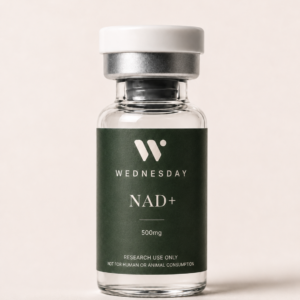 Cellular Energy & Neuro Research
NAD+
500 mg / 1000 mg View listing →
Cellular Energy & Neuro Research
NAD+
500 mg / 1000 mg View listing →
Frequently asked questions
Is NMN or NR better for raising NAD+?
In the only head-to-head human trial published to date, NR and NMN raised circulating NAD+ to a similar degree, roughly twofold, after 14 days. Tracer studies in mice show both are largely converted to nicotinamide before NAD+ is rebuilt in tissue. The literature does not support a clear winner on blood NAD+ levels.
Why was NMN banned by the FDA?
It was not banned as a substance. In November 2022 FDA concluded that NMN was excluded from the legal definition of a dietary supplement because it had been authorized for drug investigation before being marketed as a supplement. In September 2025 FDA reversed that conclusion after finding evidence of earlier supplement marketing.
Can NAD+ be absorbed directly?
NAD+ is a charged dinucleotide that does not cross cell membranes efficiently. Extracellular enzymes can break it into NMN and NR, which cells import and rebuild. A small intravenous study found plasma NAD+ did not rise for about two hours during infusion, consistent with rapid uptake or breakdown. Oral NAD+ pharmacokinetics have not been published.
What is the difference between NMN and NAD+?
NMN is a mononucleotide made of nicotinamide, ribose and one phosphate. NAD+ is NMN joined to adenosine monophosphate, making it a dinucleotide about twice the size. The enzyme NMNAT converts NMN to NAD+ in one step inside the cell.
Is NR a form of vitamin B3?
Yes. Nicotinamide riboside is one of several vitamin B3 forms, alongside nicotinic acid (niacin) and nicotinamide (niacinamide). Like the others it is a precursor to NAD+, but it enters the salvage pathway through nicotinamide riboside kinases rather than through NAMPT.
References & further reading
- Covarrubias AJ, Perrone R, Grozio A, Verdin E. NAD+ metabolism and its roles in cellular processes during ageing. Nat Rev Mol Cell Biol. 2021;22(2):119–141. doi:10.1038/s41580-020-00313-x / PMID 33353981
- Ratajczak J, Joffraud M, Trammell SAJ, et al. NRK1 controls nicotinamide mononucleotide and nicotinamide riboside metabolism in mammalian cells. Nat Commun. 2016;7:13103. doi:10.1038/ncomms13103
- Grozio A, Mills KF, Yoshino J, et al. Slc12a8 is a nicotinamide mononucleotide transporter. Nat Metab. 2019;1(1):47–57. doi:10.1038/s42255-018-0009-4
- Liu L, Su X, Quinn WJ 3rd, et al. Quantitative analysis of NAD synthesis-breakdown fluxes. Cell Metab. 2018;27(5):1067–1080.e5. doi:10.1016/j.cmet.2018.03.018
- Yaku K, Palikhe S, Iqbal T, et al. Nicotinamide riboside and nicotinamide mononucleotide facilitate NAD+ synthesis via enterohepatic circulation. Sci Adv. 2025;11(12):eadr1538. doi:10.1126/sciadv.adr1538
- Martens CR, Denman BA, Mazzo MR, et al. Chronic nicotinamide riboside supplementation is well-tolerated and elevates NAD+ in healthy middle-aged and older adults. Nat Commun. 2018;9:1286. doi:10.1038/s41467-018-03421-7
- Yoshino M, Yoshino J, Kayser BD, et al. Nicotinamide mononucleotide increases muscle insulin sensitivity in prediabetic women. Science. 2021;372(6547):1224–1229. doi:10.1126/science.abe9985 / PMID 33888596
- Christen S, Redeuil K, Goulet L, et al. The differential impact of three different NAD+ boosters on circulatory NAD and microbial metabolism in humans. Nat Metab. 2026;8(1):62–73. doi:10.1038/s42255-025-01421-8
- Grant R, Berg J, Mestayer R, et al. A pilot study investigating changes in the human plasma and urine NAD+ metabolome during a 6 hour intravenous infusion of NAD+. Front Aging Neurosci. 2019;11:257. doi:10.3389/fnagi.2019.00257
- FDA declares NMN lawful in dietary supplements. NutraIngredients. 30 September 2025. nutraingredients.com