Key takeaways
- Ipamorelin is a five-amino-acid synthetic agonist of the ghrelin receptor, designed at Novo Nordisk in the 1990s from the earlier peptide GHRP-1.
- Its “selective” label comes from animal studies in which it released growth hormone at doses that did not raise ACTH, cortisol or prolactin, unlike GHRP-6 and GHRP-2.
- Human data consist of a Phase 1 pharmacokinetic study and Phase 2 trials in postoperative ileus, a gut-motility indication where it did not outperform placebo.
- No published human study has examined ipamorelin for growth-hormone-related outcomes, and it is not an approved drug in any jurisdiction.
Among the synthetic growth-hormone secretagogues, ipamorelin occupies an unusual position. It was designed by a major pharmaceutical company with a clear pharmacological goal, characterized carefully in animals, taken into human trials for an indication that had nothing to do with growth hormone, and then abandoned. The result is a compound with a genuinely informative preclinical record, a thin but real human pharmacokinetic dataset, and a large gap where most people assume the evidence sits. This note reviews what was published, in what models, and what each finding can and cannot support.
Where ipamorelin came from
The story begins with a receptor nobody had a ligand for. In the 1970s and 1980s, Cyril Bowers and colleagues synthesized small peptides derived from enkephalin that released growth hormone from pituitary cells through a mechanism that was clearly not the GHRH receptor. These GH-releasing peptides, GHRP-6 first, later GHRP-1 and GHRP-2, worked in animals and humans, but their receptor was unknown until 1996, when Merck scientists cloned the growth-hormone secretagogue receptor, GHS-R1a. Three years later Kojima and colleagues identified its natural ligand, ghrelin, in rat stomach.1 Ipamorelin was designed inside that window, when the receptor was known but the hormone was not.
Novo Nordisk’s medicinal chemists set out to reduce GHRP-1 to the smallest structure that retained GH-releasing activity while eliminating a side effect seen with the earlier peptides: release of ACTH and, downstream, cortisol. The result, coded NNC 26-0161, was a pentapeptide, Aib-His-D-2-Nal-D-Phe-Lys-NH2. Three of its five residues are non-natural (aminoisobutyric acid, D-2-naphthylalanine and D-phenylalanine), which protects it from proteases and locks in a receptor-binding shape. Its molecular weight is 711.9 Da, making it one of the smallest peptides in the GH-axis literature.2
The selectivity claim, and what supports it
The foundational paper is Raun and colleagues’ 1998 report in the European Journal of Endocrinology, titled without hedging “Ipamorelin, the first selective growth hormone secretagogue.”2 The study worked at three levels. In primary rat pituitary cell cultures, ipamorelin released GH with a potency and maximal effect comparable to GHRP-6, and the response was blocked by a GHS-R antagonist but not by a GHRH antagonist, placing its action on the secretagogue receptor. In anesthetized rats given intravenous doses, GH rose dose-dependently. The critical comparison came in swine: at doses producing GH release similar to GHRP-6 and GHRP-2, ipamorelin did not produce a significant increase in ACTH or cortisol, whereas the comparator peptides did. Prolactin, which GHRP-6 also raises, was likewise unaffected.
“Selective” in this context has a precise meaning: selective for GH release over the other pituitary hormones that ghrelin-receptor agonists can trigger. It does not mean that ipamorelin binds only GHS-R1a and nothing else, a claim the paper did not make and did not test. The selectivity was demonstrated in rat and pig; the human study that followed measured GH but did not report a parallel cortisol comparison across secretagogues.
Ipamorelin’s reputation rests on what it did not do in pigs, raise cortisol and prolactin, as much as on what it did.
Animal findings on bone
Two further Novo Nordisk studies looked at downstream effects of sustained GH release. Johansen and colleagues reported in 1999 that ipamorelin increased longitudinal bone growth in young rats, measured by tibial length and growth-plate width, an effect consistent with the known action of GH on the epiphyseal plate.3 Andersen and colleagues then used adult rats treated with a glucocorticoid to suppress bone formation and found that ipamorelin co-treatment counteracted the decrease in bone-formation markers and periosteal bone growth.4 Both studies are best read as demonstrations that ipamorelin-driven GH release was biologically meaningful in the rat, rather than as evidence about any particular skeletal condition. Neither has been replicated in another species or followed by human work.
| Level of evidence | What was studied | Principal finding | Limits |
|---|---|---|---|
| In vitro | Rat pituitary cell cultures2 | GH release via the secretagogue receptor; potency similar to GHRP-6 | Isolated cells; no systemic feedback |
| In vivo, animal | Rats and swine2,3,4 | GH release without ACTH, cortisol or prolactin rise; bone growth effects in rats | Acute or short-term; two species; one laboratory |
| Human, Phase 1 | Healthy volunteers, IV dosing5 | Half-life about 2 h; dose-dependent GH response modeled | Small; pharmacokinetic focus |
| Human, Phase 2 | Postoperative ileus after bowel resection6,7 | No significant difference from placebo on GI recovery | Not a GH-axis study; program discontinued |
Human pharmacokinetics
The single published human pharmacology paper is Gobburu and colleagues’ pharmacokinetic–pharmacodynamic analysis of intravenous ipamorelin in healthy volunteers.5 They fit a two-compartment model with an elimination half-life of roughly two hours and linked plasma concentration to GH response through an indirect-response model in which ipamorelin stimulates GH release into the circulation. The GH response was dose-dependent and, as with other secretagogues, showed the pulsatile, self-limiting character of the axis rather than a sustained plateau. The value of this paper is that it anchors the compound’s human time course; its limitation is that it was a single-dose study in a small group, designed to characterize kinetics rather than any outcome.
The postoperative-ileus trials
Ghrelin receptors are expressed in the enteric nervous system as well as the pituitary, and ghrelin itself accelerates gastric emptying in animals. That biology led Helsinn Therapeutics, which licensed ipamorelin, to test it as a treatment for postoperative ileus, the temporary shutdown of gut motility after abdominal surgery. Beck and colleagues published the Phase 2 proof-of-concept trial in 2014: 114 patients undergoing bowel resection were randomized to intravenous ipamorelin or placebo twice daily for up to seven days.6 The primary endpoint, time to first tolerated meal, did not differ significantly between groups, and neither did time to first bowel movement or hospital discharge. Adverse-event rates were similar. A larger registered trial with the same design (NCT01280344) followed, and the program was subsequently discontinued.7
Two points deserve emphasis. First, this remains the largest controlled human dataset on ipamorelin, and it was negative for the question it asked. Second, the question was gastrointestinal, not endocrine; the trial did not report GH or IGF-1 as outcomes and says nothing about the compound’s GH-axis effects in humans beyond general tolerability at the doses studied. Reviews of GH secretagogues as a class note the same pattern for ipamorelin specifically: promising animal pharmacology, and a human record that is small and off-target.8
Reading the evidence
It is common to see ipamorelin described online with a list of effects on body composition, sleep or recovery. None of those outcomes has been measured in a published human study of ipamorelin. The claims are extrapolations from GH physiology or from studies of other secretagogues, and readers should treat them as hypotheses, not findings. Ipamorelin is not approved anywhere and has been the subject of FDA compounding-policy review in the United States.9
How ipamorelin is used in current research
In contemporary laboratory work, ipamorelin serves mainly as a tool compound: a stable, small, well-characterized GHS-R1a agonist that can probe ghrelin-receptor signaling without the confounding ACTH response of GHRP-6. That role is why it is frequently paired with a GHRH analog in experimental designs, a rationale explained in CJC-1295 and Ipamorelin: Why Researchers Study Them Together and rooted in the 1990 demonstration that GHRH and GH-releasing peptides act synergistically on GH release in humans.10 Because the natural ligand ghrelin is acylated and unstable, a non-acylated synthetic agonist with a two-hour half-life is a practical substitute in cell and animal work.
For research-grade material, the relevant quality questions are identity and purity. Ipamorelin’s small size and non-natural residues give it a distinctive mass and chromatographic signature, so a certificate of analysis should show a mass-spectrometry match to 711.9 Da and an HPLC purity figure with the method stated. Wednesday’s COA library carries per-lot results; the note on Understanding Peptide Purity explains why the number alone is not the whole story.
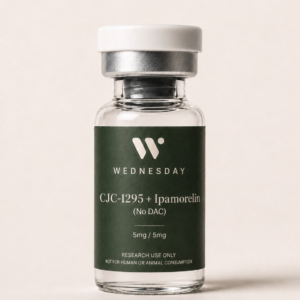 GH-Axis Research
CJC-1295 + Ipamorelin
CJC-1295 / Ipamorelin 5 mg + 5 mg blend View listing →
GH-Axis Research
CJC-1295 + Ipamorelin
CJC-1295 / Ipamorelin 5 mg + 5 mg blend View listing →
Frequently asked questions
What does ipamorelin do?
In animal studies, ipamorelin binds the ghrelin receptor on pituitary cells and causes release of the animal’s own growth hormone. Its distinguishing feature in those studies was that it did so without raising ACTH, cortisol or prolactin, which older GH-releasing peptides did. Human studies have measured its pharmacokinetics and tested it for postoperative gut recovery, where it did not beat placebo.
Is ipamorelin the same as growth hormone?
No. Growth hormone is a 191-amino-acid protein made by the pituitary. Ipamorelin is a synthetic five-amino-acid peptide that signals the pituitary to release GH in experimental models. It contains no GH and works upstream of it.
Has ipamorelin been studied in humans?
Yes, but narrowly. A Phase 1 study characterized its two-hour half-life and GH response in healthy volunteers. Phase 2 trials tested it for postoperative ileus after bowel surgery and found no significant benefit over placebo. No human study has examined GH-related outcomes such as body composition.
Why is ipamorelin called selective?
Because in the 1998 Novo Nordisk study, doses that released GH in rats and pigs did not significantly raise ACTH, cortisol or prolactin, whereas GHRP-6 and GHRP-2 did. The term refers to selectivity for GH over other pituitary hormones, not to binding a single receptor exclusively.
Is ipamorelin FDA approved?
No. Ipamorelin is not approved for any indication in any country. Its development for postoperative ileus was discontinued, and in the United States it has been reviewed under FDA’s bulk-drug-substance compounding policy. Material sold for research is not a pharmaceutical product.
References & further reading
- Kojima M, Hosoda H, Date Y, Nakazato M, Matsuo H, Kangawa K. Ghrelin is a growth-hormone-releasing acylated peptide from stomach. Nature. 1999;402(6762):656–660. doi:10.1038/45230 / PMID 10604470
- Raun K, Hansen BS, Johansen NL, et al. Ipamorelin, the first selective growth hormone secretagogue. Eur J Endocrinol. 1998;139(5):552–561. doi:10.1530/eje.0.1390552 / PMID 9849822
- Johansen PB, Nowak J, Skjaerbaek C, et al. Ipamorelin, a new growth-hormone-releasing peptide, induces longitudinal bone growth in rats. Growth Horm IGF Res. 1999;9(2):106–113. doi:10.1054/ghir.1999.9998 / PMID 10373343
- Andersen NB, Malmlöf K, Johansen PB, Andreassen TT, Ørtoft G, Oxlund H. The growth hormone secretagogue ipamorelin counteracts glucocorticoid-induced decrease in bone formation of adult rats. Growth Horm IGF Res. 2001;11(5):266–272. doi:10.1054/ghir.2001.0239
- Gobburu JV, Agersø H, Jusko WJ, Ynddal L. Pharmacokinetic-pharmacodynamic modeling of ipamorelin, a growth hormone releasing peptide, in human volunteers. Pharm Res. 1999;16(9):1412–1416. doi:10.1023/A:1018955126402 / PMID 10496658
- Beck DE, Sweeney WB, McCarter MD; Ipamorelin 201 Study Group. Prospective, randomized, controlled, proof-of-concept study of the Ghrelin mimetic ipamorelin for the management of postoperative ileus in bowel resection patients. Int J Colorectal Dis. 2014;29(12):1527–1534. doi:10.1007/s00384-014-2030-8 / PMID 25331030
- Helsinn Therapeutics. Safety and efficacy of ipamorelin compared to placebo for the recovery of gastrointestinal function. ClinicalTrials.gov identifier NCT01280344. clinicaltrials.gov/study/NCT01280344
- Sigalos JT, Pastuszak AW. The safety and efficacy of growth hormone secretagogues. Sex Med Rev. 2018;6(1):45–53. doi:10.1016/j.sxmr.2017.02.004 / PMID 28400207
- U.S. Food and Drug Administration. Certain bulk drug substances for use in compounding that may present significant safety risks. fda.gov
- Bowers CY, Reynolds GA, Durham D, Barrera CM, Pezzoli SS, Thorner MO. Growth hormone (GH)-releasing peptide stimulates GH release in normal men and acts synergistically with GH-releasing hormone. J Clin Endocrinol Metab. 1990;70(4):975–982. doi:10.1210/jcem-70-4-975