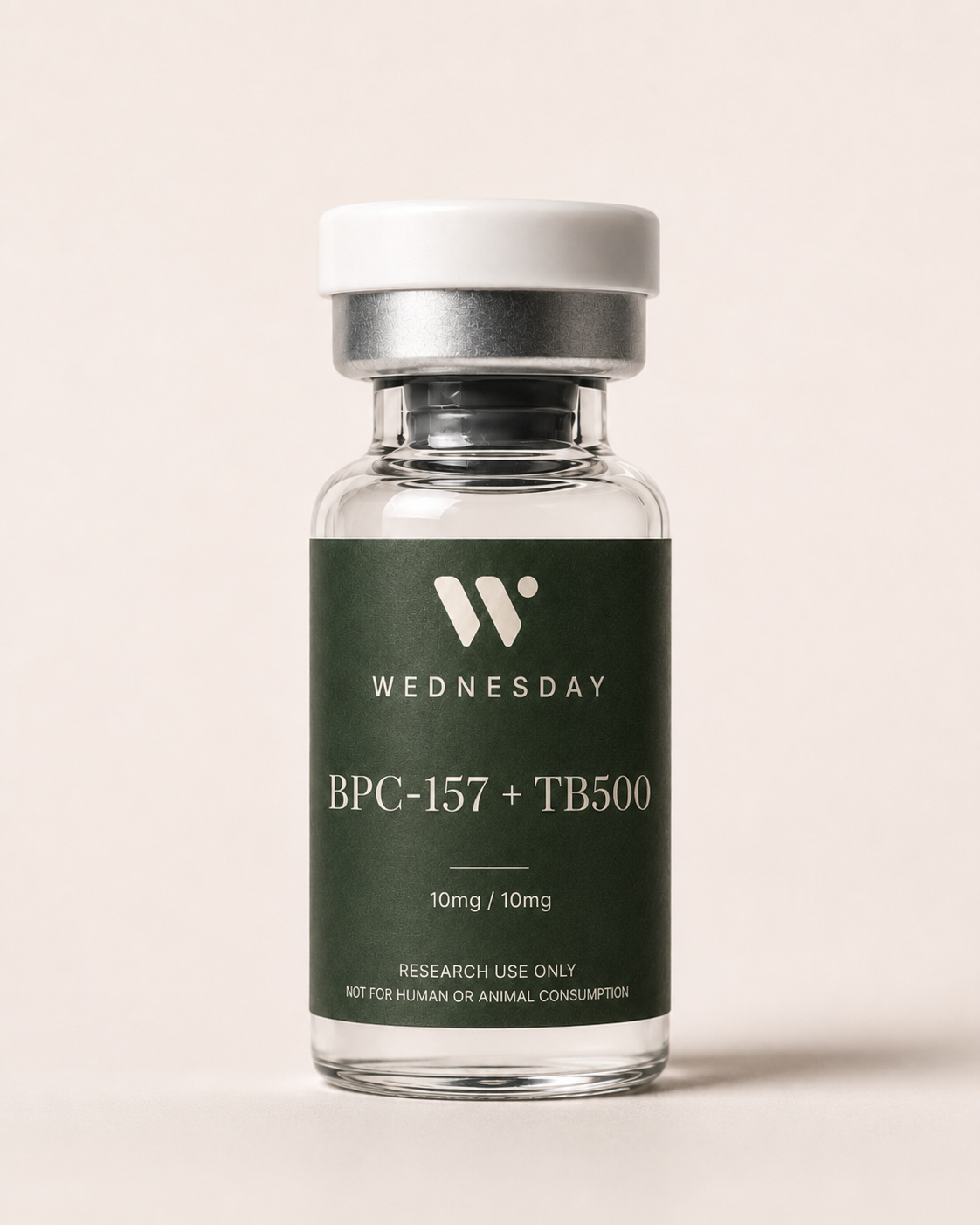
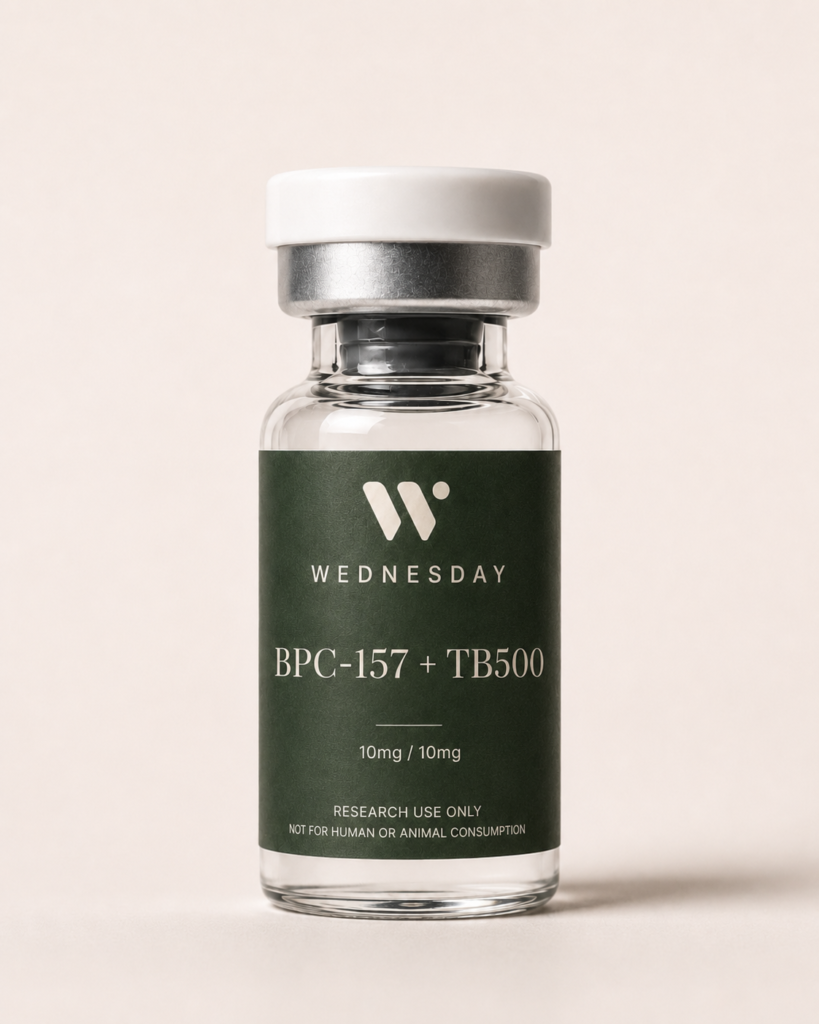
Wolverine
Current listing
Wolverine - 10mg / 10mg blend listing for BPC-157 + TB-500 tissue-repair research.
Add to cart
Select quantity and add this listing to your order.
Research-use listing. For qualified laboratory research use only. No product-use instructions are provided.
In stock
Need BAC Water?
BAC Water is available for applicable laboratory orders and can also be ordered on its own.
Overview
Wolverine is a BPC-157 + TB-500 research blend used to examine complementary tissue-repair, cell-migration, angiogenesis, and inflammatory-signaling mechanisms.
BPC-157 is commonly associated with cytoprotective and angiogenesis-related research, while TB-500 is discussed in actin-binding and cell-migration models.
Potential research applications
- Dual-pathway tissue-repair mechanism studies
- Angiogenesis and VEGF expression research
- Tendon, ligament, muscle, and soft-tissue model research
- Cytokine-response and inflammatory-modulation profiling
- Cell migration, actin polymerization, wound-closure, and barrier-function assays
Research-use limits
For qualified laboratory research use only. This page does not provide protocols, product-use instructions, clinical guidance, outcome claims, or internal sourcing and batch details.
Order notes
Catalog listings can be added with quantity selection.
From the research library
BPC-157 Research Overview: What Preclinical Studies Actually Show
Three decades of rodent studies, a handful of mechanistic papers, and no published human trial. A plain-language map of the BPC-157 literature.
Understanding Peptide Purity: What 99% Does and Doesn’t Tell You
A purity figure is a chromatographic ratio, not a statement about everything in the vial. What the number measures, what it leaves out and how to read it.
BPC-157 vs. TB-500: Different Mechanisms, Overlapping Research Interest
One is a gastric peptide acting through VEGFR2 and nitric oxide; the other is a fragment of an actin-binding protein. A side-by-side reading of the evidence.