Key takeaways
- BPC-157 is a 15-amino-acid fragment of a gastric protein studied mainly in rodent injury models; TB-500 is a seven-residue fragment of thymosin beta-4, a ubiquitous actin-binding protein.
- The proposed mechanisms barely overlap: BPC-157 has been linked to VEGFR2 signaling, nitric oxide and growth-hormone-receptor expression, while thymosin beta-4 acts through actin dynamics and cell migration.
- Full-length thymosin beta-4 has human safety and Phase 2 efficacy data from a pharmaceutical program; BPC-157 and TB-500 itself have none.
- A 2026 rat tendon study that tested both peptides and their combination found no additive effect, which is the only direct experimental comparison published so far.
BPC-157 and TB-500 are the two peptides most often mentioned in the same sentence in tissue-repair research, and the pairing has become so routine that their differences are easy to lose. They arrived from opposite directions. BPC-157 emerged from gastroenterology as a fragment of a protective gastric protein, and its literature is a long series of rodent injury models. TB-500 is a short piece of thymosin beta-4, one of the most abundant proteins in human cells, whose biology was worked out by cytoskeleton researchers before anyone thought about repair. They are studied together because both show up in wound and tendon models, not because they share a mechanism. This note puts the two side by side on origin, mechanism, evidence and analytics, and closes with the single experiment that has tested them head to head.
Origins
BPC-157 was reported by Predrag Sikiric’s group in Zagreb in the early 1990s as a stable 15-residue fragment of a “body protection compound” in human gastric juice. The parent protein has never been fully characterized, and the peptide used in research is entirely synthetic. Its early studies concerned protection of the stomach lining; the tendon, ligament and vascular work came later and largely from the same laboratory.1
Thymosin beta-4 has a longer and more conventional history. Isolated from thymus in the 1960s and initially mistaken for a hormone, it was identified in 1991 as the principal actin-sequestering protein of the cytoplasm, the molecule that keeps a reserve of actin subunits ready for cells to build filaments when they need to move.2 Its repair biology was established by Hynda Kleinman’s group at the NIH in the late 1990s, and a pharmaceutical company, RegeneRx, took full-length Tβ4 into clinical trials. TB-500 is a synthetic peptide built around residues 17–23 of Tβ4, the actin-binding motif LKKTETQ, and it entered the literature mainly through anti-doping laboratories after appearing in horse racing. The two are not the same molecule, a distinction that matters throughout this comparison.
Proposed mechanisms
For BPC-157, three mechanistic leads have been proposed, each by a different route. Chang and colleagues in Taiwan found that the peptide increased tendon fibroblast migration through phosphorylation of focal adhesion kinase and paxillin, and separately that it raised expression of the growth hormone receptor in those cells.3 Hsieh and colleagues, also in Taiwan, traced its pro-angiogenic effect to activation of VEGFR2 and downstream Akt–eNOS signaling in endothelial cells.4 The Zagreb group has long emphasized interaction with the nitric oxide system, a topic covered in BPC-157 and the Nitric Oxide System. None of these has been confirmed as the primary mechanism, and no receptor for BPC-157 has been identified.
For thymosin beta-4, the mechanism is better anchored. The protein binds G-actin one to one and regulates the monomer pool that cell movement depends on.2 That is the root of its effects on keratinocyte and endothelial migration in wound models,5 and Philp and colleagues showed in 2003 that the actin-binding motif alone reproduced the pro-angiogenic activity of the full protein in cell assays.6 Cardiac studies added integrin-linked kinase and Akt activation as a survival signal.7 The question for TB-500 is not whether Tβ4’s mechanism is real but how much of it a seven-residue fragment retains, and the 2003 paper remains the main evidence on that point.
The two peptides are paired by habit, not by biology: one talks to blood vessels and nitric oxide, the other to the cytoskeleton.
| Dimension | BPC-157 | TB-500 (Tβ4 fragment) |
|---|---|---|
| Origin | Fragment of a gastric-juice protein; synthetic | Fragment of thymosin beta-4, a ubiquitous cellular protein; synthetic |
| Size | 15 amino acids; ~1,419 Da | 7 amino acids (Ac-LKKTETQ); ~889 Da |
| Proposed mechanism | VEGFR2–Akt–eNOS; FAK–paxillin; GH-receptor upregulation; NO-system modulation3,4 | Actin sequestration and cell migration; ILK–Akt survival signaling (full Tβ4)2,6,7 |
| Main preclinical models | Rat gastric lesions, tendon and ligament transection, colitis, ischemia1 | Rat and mouse skin wounds, corneal injury, myocardial infarction (full Tβ4)5,7 |
| Independent replication | Limited; most in vivo work from one group | Extensive for Tβ4; minimal for the fragment |
| Human data | None published in controlled trials8 | Phase 1 IV safety and Phase 2 ophthalmic trials of full Tβ4; none for TB-5009 |
| Regulatory | Unapproved; WADA-prohibited since 2022 | Unapproved; WADA-prohibited; Tβ4 drug candidates unapproved |
| Detection | Confirmed in confiscated products; LC-MS methods exist | Equine and human anti-doping LC-MS methods |
The weight of evidence
Judged by volume, BPC-157 has the larger literature, well over a hundred rodent papers. Judged by independence and translation, thymosin beta-4 is ahead. Tβ4’s wound-healing effects have been reproduced by unrelated laboratories across species, its cardiac effects were published in Nature by two separate groups, and a Phase 1 study established the safety of intravenous Tβ4 in healthy volunteers with Phase 2 trials following in dry eye.9 BPC-157’s tendon and angiogenesis mechanisms have independent support from the Taiwan groups, but the core in vivo healing findings remain largely the work of the originating laboratory, and a 2025 systematic review found no randomized human study of any kind.1,8
The asymmetry reverses at the level of the actual research compound. The human data for Tβ4 belong to the 43-residue protein, not to the seven-residue TB-500, which has never been given to a person in a published study. BPC-157, whatever its limitations, is at least the same molecule in the rat papers and in the vial. A researcher comparing the two should therefore be careful about which body of evidence is being invoked: Tβ4’s record is stronger, but TB-500 inherits only a fraction of it.
The one head-to-head experiment
Until 2026, no controlled study had tested BPC-157 and TB-500 against each other or in combination. In July 2026, Biçer and colleagues at a Turkish orthopedic center published a rat Achilles tendon study with four arms, vehicle, BPC-157, TB-500 and both together, assessed at four weeks by biomechanical testing and histology.10 TB-500 was the only arm with a statistically significant improvement in maximum load to failure, and it also had the best histological scores of tendon organization. BPC-157 improved some histological measures without reaching significance on the composite score. The combination was no better than either peptide alone on any outcome. With four animals per group per outcome and a single timepoint, the study is small, and Wednesday’s news note on the paper discusses its limits. But it is the only direct comparison in the literature, and its central finding, no additive effect, is the opposite of the assumption behind combining the two.
Reading the evidence
Everything above concerns cells and animals except the Tβ4 trials, which used a pharmaceutical formulation of the full protein that is not TB-500 and not research-grade material. Neither BPC-157 nor TB-500 is approved anywhere. Statements that one “works better” than the other for any purpose in people have no evidentiary basis; the honest comparison is between two preclinical records of different shape.
Why they are studied together anyway
The rationale for combining the two is a division-of-labor hypothesis: BPC-157 acts on blood supply and local signaling while TB-500 acts on the cells that migrate into a wound, so together they might address more of the repair process than either alone. It is a reasonable hypothesis, and the fact that the mechanisms are distinct makes it more interesting than combining two compounds that do the same thing. The 2026 study is the first test of it, and the result did not support additivity in that model. Whether that reflects a ceiling effect in the assay, a dosing issue or genuine redundancy in the pathways is unknown. The design questions raised by testing two active compounds at once, factorial arms, controls for each component, the attribution problem, are the subject of Peptide Blends in Research.
Analytically, the two peptides are easy to distinguish. Their masses differ by more than 500 Da, their retention times on reversed-phase HPLC are distinct, and a certificate of analysis for a combined preparation should report identity and purity for each separately. Wednesday supplies the pair as the Wolverine blend; the COA library shows per-component results, and the BPC-157 and TB-500 overviews cover each compound’s literature in depth.
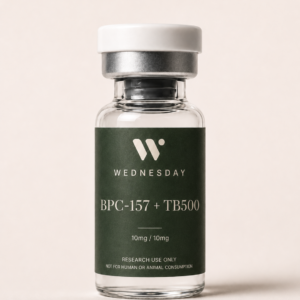 Tissue Repair Research
Wolverine
BPC-157 10 mg + TB-500 10 mg View listing →
Tissue Repair Research
Wolverine
BPC-157 10 mg + TB-500 10 mg View listing →
Frequently asked questions
What is the difference between BPC-157 and TB-500?
BPC-157 is a 15-amino-acid synthetic fragment of a gastric protein, studied mostly in rat injury models and linked to VEGFR2, nitric oxide and growth-hormone-receptor signaling. TB-500 is a 7-amino-acid fragment of thymosin beta-4, a protein that regulates actin and cell movement. They differ in origin, size, mechanism and evidence base.
Is TB-500 the same as thymosin beta-4?
No. Thymosin beta-4 is a 43-amino-acid natural protein with extensive animal research and human clinical trials. TB-500 is a short synthetic peptide containing its actin-binding motif. The human safety and efficacy data belong to the full protein, not the fragment.
Which has more research, BPC-157 or TB-500?
BPC-157 has more published papers, but most are rodent studies from one laboratory. Thymosin beta-4 has fewer papers but broader independent replication and human trial data. TB-500 itself has very little research beyond anti-doping detection methods and one fragment-activity study.
Do BPC-157 and TB-500 work better together?
The only controlled test, a 2026 rat Achilles tendon study, found that combining the two produced no additive effect on strength or histology compared with either alone. That is a single small animal study, but it does not support the assumption that the combination is superior. No human data exist for either compound.
Has either BPC-157 or TB-500 been approved by the FDA?
No. Neither is approved for any use in any country. Full-length thymosin beta-4 has been in clinical trials for eye conditions but is also unapproved. Both peptides are prohibited in sport by WADA.
References & further reading
- Sikiric P, Seiwerth S, Rucman R, et al. Stable gastric pentadecapeptide BPC 157: novel therapy in gastrointestinal tract. Curr Pharm Des. 2011;17(16):1612–1632. doi:10.2174/138161211796196954 / PMID 21548867
- Safer D, Elzinga M, Nachmias VT. Thymosin beta 4 and Fx, an actin-sequestering peptide, are indistinguishable. J Biol Chem. 1991;266(7):4029–4032. PMID 1999398
- Chang CH, Tsai WC, Lin MS, Hsu YH, Pang JH. The promoting effect of pentadecapeptide BPC 157 on tendon healing involves tendon outgrowth, cell survival, and cell migration. J Appl Physiol. 2011;110(3):774–780. doi:10.1152/japplphysiol.00945.2010 / PMID 21030672
- Hsieh MJ, Liu HT, Wang CN, et al. Therapeutic potential of pro-angiogenic BPC157 is associated with VEGFR2 activation and up-regulation. J Mol Med (Berl). 2017;95(3):323–333. doi:10.1007/s00109-016-1488-y
- Malinda KM, Sidhu GS, Mani H, et al. Thymosin β4 accelerates wound healing. J Invest Dermatol. 1999;113(3):364–368. doi:10.1046/j.1523-1747.1999.00708.x
- Philp D, Huff T, Gho YS, Hannappel E, Kleinman HK. The actin binding site on thymosin β4 promotes angiogenesis. FASEB J. 2003;17(14):2103–2105. doi:10.1096/fj.03-0121fje
- Bock-Marquette I, Saxena A, White MD, DiMaio JM, Srivastava D. Thymosin β4 activates integrin-linked kinase and promotes cardiac cell migration, survival and cardiac repair. Nature. 2004;432(7016):466–472. doi:10.1038/nature03000
- Vasireddi N, et al. Emerging use of BPC-157 in orthopaedic sports medicine: a systematic review. HSS J. 2025;21(4). doi:10.1177/15563316251355551 / PMID 40756949
- Ruff D, Crockford D, Girardi G, Zhang Y. A randomized, placebo-controlled, single and multiple dose study of intravenous thymosin β4 in healthy volunteers. Ann N Y Acad Sci. 2010;1194:223–229. doi:10.1111/j.1749-6632.2010.05474.x
- Biçer O, Adanir O, Güleryüz Y, et al. Effects of BPC-157 and TB-500 on Achilles tendon healing in rats: a histopathological and biomechanical study. Jt Dis Relat Surg. 2026;37(3):822–837. doi:10.52312/jdrs.2026.2951