Key takeaways
- Lyophilization freezes a peptide solution and then removes the ice by sublimation under vacuum, leaving a dry, porous solid without ever heating the sample.
- Water is the medium for nearly every reaction that degrades a peptide, so removing it slows hydrolysis, deamidation, oxidation and microbial growth by orders of magnitude.
- The process has three stages, freezing, primary drying and secondary drying, and the temperature at each stage is constrained by the physics of the frozen solution.
- A well-formed lyophilized cake is a sign of a controlled process; a collapsed, melted or discolored one is a reason to look more closely at the certificate of analysis.
Open a vial of research peptide and there is no liquid inside, only a small white cake or a film of powder that seems too little to weigh. This is lyophilized material, and the reason it arrives that way is not convenience but chemistry. A peptide dissolved in water is a molecule under continuous low-level attack: from the water itself, from dissolved oxygen, from trace metals and from whatever microorganisms find their way in. Remove the water and most of those attacks stop. Lyophilization, or freeze-drying, is the method that removes water without exposing the peptide to heat, and it has been the standard presentation for peptide and protein pharmaceuticals for decades.1,2 This note explains what the process does, why it works, and how to read the result in the vial.
Why water is the problem
Peptides in aqueous solution degrade by a small number of well-characterized routes, and almost all of them require water either as a reactant or as the medium that lets reactants meet.1,3
- Hydrolysis of the peptide bond itself, which is slow at neutral pH but accelerates at acidic or basic pH and at aspartate residues, where the side chain assists the reaction.
- Deamidation of asparagine and glutamine, in which the side-chain amide is converted to a carboxylic acid via a cyclic intermediate, changing the peptide’s charge and often its activity. Asn-Gly sequences are the most susceptible.
- Oxidation of methionine, cysteine, tryptophan, histidine and tyrosine by dissolved oxygen, peroxides or light, often catalyzed by trace metal ions.
- Racemization and beta-elimination, slower but relevant over long storage.
- Aggregation, in which peptide molecules associate through hydrophobic contacts, sometimes forming insoluble fibrils.
- Microbial contamination, since an unpreserved peptide solution is a growth medium.
Every one of these depends on molecular mobility. In a dry solid, molecules cannot diffuse to find reaction partners, water is not available as a reactant, and the peptide chain is held rigid. Degradation does not stop entirely in the solid state, but its rate falls by orders of magnitude, which is why a lyophilized peptide stored cold and dry can remain within specification for years while the same peptide in solution may show new impurity peaks within days.1,3
Why not simply evaporate the water?
Drying a solution by heating it concentrates the peptide, raises the temperature, and shifts the pH as buffer components concentrate, all of which accelerate exactly the reactions one is trying to prevent. Surface tension during evaporation also drives aggregation. Freeze-drying avoids these problems by keeping the sample frozen throughout the water-removal step and by removing the water as vapor directly from ice, a phase change called sublimation. The peptide never experiences a concentrated liquid state at elevated temperature.2,4
The three stages
Freezing
The peptide solution, in its final vial, is cooled on the shelves of the lyophilizer, typically to −40 °C or below. As ice crystals form, the peptide and any other solutes are excluded from the crystals and concentrated into the spaces between them. This freeze-concentrate does not itself crystallize; it becomes a glassy amorphous phase whose properties are set by its glass transition temperature, written Tg′. The freezing rate controls ice crystal size and therefore the pore structure of the eventual cake: fast freezing gives small crystals and a fine, slow-drying matrix, while slower or controlled nucleation gives larger crystals and faster drying.5 Freezing is also a stress in its own right, since the concentration of solutes and the growth of ice surfaces can denature proteins, although small peptides with no fold to lose are far less affected.
Primary drying
The chamber is evacuated to a pressure well below the vapor pressure of ice, typically 50 to 200 microbar, and the shelves are warmed slightly to supply the energy of sublimation. Ice sublimes directly to vapor, which travels to a condenser held far colder than the product and refreezes there. Throughout this stage the product temperature must stay below the collapse temperature of the freeze-concentrate, which is close to Tg′. If it rises above that point the amorphous matrix softens and flows, the pore structure collapses, and the cake shrinks or melts back. Primary drying is the longest stage, often lasting a day or more, because the sublimation front must move from the top of the cake to the bottom while heat is supplied from below.2,4
Secondary drying
When the ice is gone, the cake still contains water bound within the amorphous solid, often 5 to 10 percent by weight. The shelf temperature is raised, sometimes to 20 to 40 °C, and held under vacuum to desorb this residual moisture. The target for most peptide and protein products is below 1 to 3 percent residual water, because stability in the solid state correlates strongly with dryness and because water acts as a plasticizer that lowers the glass transition temperature of the cake.1,2 After secondary drying, vials are stoppered under vacuum or under an inert gas such as nitrogen and sealed.
| Stage | What happens | Typical conditions | Critical constraint |
|---|---|---|---|
| Freezing | Solution solidifies; solutes concentrate into an amorphous glass between ice crystals | Shelf −40 to −50 °C; hours | Product must fall well below Tg′; freezing rate sets pore structure |
| Primary drying | Ice sublimes under vacuum and is trapped on a cold condenser | Chamber 50–200 µbar; shelf −30 to −10 °C; one to several days | Product temperature must stay below collapse temperature |
| Secondary drying | Bound water desorbs from the amorphous solid | Shelf 20–40 °C under vacuum; hours | Reach target residual moisture without exceeding the dry cake’s Tg |
| Stoppering | Vials sealed under vacuum or nitrogen | In chamber, before venting | Exclude moisture and oxygen |
Freeze-drying does not make a peptide more stable; it removes the medium in which instability happens.
Excipients, and why research peptides often lack them
Pharmaceutical lyophilized products almost always contain excipients. Bulking agents such as mannitol or glycine give the cake mass and structure when the active ingredient is present in milligram amounts. Stabilizers such as sucrose or trehalose form a glass that surrounds the peptide and restricts its mobility, and for proteins they preserve the native fold by replacing the hydrogen bonds water would otherwise supply. Buffers hold pH during freezing, when concentration effects can shift it by several units.1,3,6
Research-grade peptides are typically lyophilized without excipients, directly from the pooled HPLC fractions. This is deliberate. Adding excipients would change the composition of the material and complicate any downstream experiment that requires a defined chemical entity. It also means that a vial containing 5 or 10 mg of peptide holds only a few milligrams of solid in total, which is why the cake is often a thin film or a small fragile disc rather than the substantial white plug seen in pharmaceutical vials. The absence of a bulking agent makes the cake appearance more variable and less diagnostic than in a formulated product.
Reading the cake
With that caveat, the physical appearance of a lyophilized peptide still carries information. A uniform white to off-white solid that occupies roughly the volume of the original frozen liquid indicates that the product stayed below its collapse temperature throughout drying. A cake that has shrunk to a dense glassy bead at the bottom of the vial, or that shows a melted or foamed appearance, suggests collapse or meltback during drying, which is associated with higher residual moisture and faster degradation on storage.4,5 Discoloration toward yellow or brown can indicate oxidation or contamination. None of these observations substitutes for the analytical data on a certificate of analysis, but an anomalous appearance is a reason to check that the certificate corresponds to the lot in hand.
Regulators treat cake appearance the same way. FDA’s inspection guide for lyophilized parenterals directs investigators to review how a manufacturer evaluates cake appearance and what is done with collapsed or partially melted vials, precisely because appearance is a visible proxy for process control.7
Limits of the method
Lyophilization protects a peptide from water, not from everything. A dry peptide remains sensitive to light, to oxygen if the vial seal is compromised, to heat, and to moisture that enters each time a vial is opened. Freeze-drying also does not remove impurities, sterilize the product or fix a poor synthesis; it preserves whatever quality the material had going in. The storage and handling note covers what happens after the seal is broken.
Reconstitution and why the diluent matters
A lyophilized cake is designed to redissolve. The porous structure left behind by sublimation has an enormous internal surface area, and water added to the vial wets it quickly; the solid typically disappears in seconds to a minute without agitation, restoring the original solution minus whatever volatile components were lost.2 Once water returns, so do all the degradation routes described above, which is why the shelf life of a reconstituted peptide is measured in days to weeks under refrigeration rather than the years available to the dry solid.
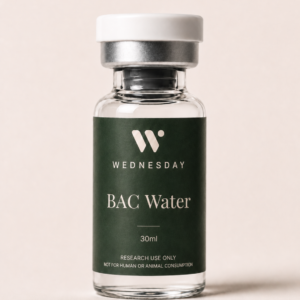
The choice of diluent affects two of those routes. Bacteriostatic water for injection, USP, is sterile water containing 0.9 percent benzyl alcohol as a preservative, intended for use as a diluent in multiple-dose applications.8 The preservative limits microbial growth in a vial that is entered more than once, addressing one degradation pathway; it does nothing for hydrolysis, deamidation or oxidation, which continue at the rates the peptide’s sequence and the solution’s pH dictate. Sterile water without preservative is appropriate where a solution will be used once or where benzyl alcohol would interfere with an assay. Our planned notes on bacteriostatic water and reconstitution arithmetic cover the choice and the calculations in laboratory terms.
 Reconstitution Support
BAC Water 30 mL
30 mL, reconstitution support View listing →
Reconstitution Support
BAC Water 30 mL
30 mL, reconstitution support View listing →
What lyophilization means for the researcher
Three practical points follow. First, the dry cake in a sealed vial is the most stable form the peptide will ever be in, and the clock on solution-phase degradation starts when water is added. Second, the mass of the cake is not the mass of peptide, because the solid includes counter-ions and residual water; the purity note explains why. Third, the certificate of analysis describes the material as it was tested, and lyophilization is what makes it reasonable to expect that description to hold until the vial is opened. Freeze-drying is the quiet step between the analytical laboratory and the research bench that lets the numbers on the certificate travel with the vial.
Frequently asked questions
What is lyophilization?
Lyophilization, or freeze-drying, is a process that removes water from a frozen solution by sublimation under vacuum. The sample is frozen, the pressure is lowered so that ice converts directly to vapor, and the vapor is trapped on a cold condenser. The result is a dry, porous solid that has never been heated above freezing during water removal.
Why are peptides freeze-dried?
Because water is the medium for the chemical reactions that degrade peptides: hydrolysis, deamidation, oxidation and microbial growth. Removing water slows all of these dramatically, so a lyophilized peptide stored cold can remain stable for years, whereas the same peptide in solution degrades over days to weeks.
What does a lyophilized peptide look like?
Usually a small white or off-white cake, disc or film at the bottom of the vial. Research peptides are lyophilized without bulking agents, so a vial holding a few milligrams of peptide contains very little visible solid. A cake that has collapsed into a dense glassy bead or appears melted may indicate that the drying process was not fully controlled.
Is lyophilized powder the same as the peptide by weight?
No. The solid in the vial includes the peptide, its counter-ions (usually trifluoroacetate from HPLC purification) and residual water. The peptide itself typically makes up 60 to 85 percent of the dry weight. Purity by HPLC and net peptide content are separate measurements that address this.
What is bacteriostatic water used for with lyophilized peptides?
Bacteriostatic water for injection is sterile water with 0.9 percent benzyl alcohol added as a preservative. In laboratory use it serves as a diluent for reconstituting lyophilized material in vials that will be entered more than once, because the preservative limits microbial growth. It does not slow chemical degradation of the peptide.
References & further reading
- Wang W. Lyophilization and development of solid protein pharmaceuticals. Int J Pharm. 2000;203(1-2):1-60. doi:10.1016/s0378-5173(00)00423-3 / PMID 10967427
- Tang X, Pikal MJ. Design of freeze-drying processes for pharmaceuticals: practical advice. Pharm Res. 2004;21(2):191-200. doi:10.1023/B:PHAM.0000016234.73023.75 / PMID 15032301
- Manning MC, Chou DK, Murphy BM, Payne RW, Katayama DS. Stability of protein pharmaceuticals: an update. Pharm Res. 2010;27(4):544-575. doi:10.1007/s11095-009-0045-6 / PMID 20143256
- Franks F. Freeze-drying of bioproducts: putting principles into practice. Eur J Pharm Biopharm. 1998;45(3):221-229. doi:10.1016/s0939-6411(98)00004-6 / PMID 9653626
- Kasper JC, Friess W. The freezing step in lyophilization: physico-chemical fundamentals, freezing methods and consequences on process performance and quality attributes of biopharmaceuticals. Eur J Pharm Biopharm. 2011;78(2):248-263. doi:10.1016/j.ejpb.2011.03.010 / PMID 21426937
- Carpenter JF, Pikal MJ, Chang BS, Randolph TW. Rational design of stable lyophilized protein formulations: some practical advice. Pharm Res. 1997;14(8):969-975. doi:10.1023/A:1012180707283 / PMID 9279875
- US Food and Drug Administration. Guide to Inspections of Lyophilization of Parenterals. Inspection Technical Guides. fda.gov
- Hospira, Inc. Bacteriostatic Water for Injection, USP: prescribing information. DailyMed, US National Library of Medicine. dailymed.nlm.nih.gov