Key takeaways
- Bacteriostatic water is Sterile Water for Injection to which 0.9 percent benzyl alcohol has been added as an antimicrobial preservative; it is otherwise pure water with no salts or buffers.
- The preservative inhibits the growth of microorganisms introduced into a multiple-dose container after it is opened; it does not sterilize a contaminated solution and has no effect on endotoxin.
- Plain sterile water has no preservative and is intended for single use; the two products serve different purposes and are not interchangeable in laboratory practice.
- Benzyl alcohol has a documented toxicity history in neonates and can affect the stability of some peptides and proteins in solution, so its presence is a formulation variable, not a neutral one.
Most research peptides ship as lyophilized powder and are dissolved before use, and the liquid used to dissolve them appears on nearly every laboratory bench that works with them. Bacteriostatic water is the most common choice. It is a simple product, defined in the United States Pharmacopeia, but it is frequently misunderstood: described as sterile when its distinguishing feature is a preservative, assumed to be inert when its preservative is a reactive small molecule, and confused with sterile water, which is a different product with a different purpose. This note describes what bacteriostatic water is, how its preservative works, where the preservative’s limits and hazards are documented, and how it compares to the alternatives a laboratory might use. It does not address how any peptide should be prepared; that is a question for the research protocol governing the work.
What bacteriostatic water is
Bacteriostatic Water for Injection, USP, is a nonpyrogenic, sterile preparation of water for injection containing 0.9 percent (9 milligrams per milliliter) benzyl alcohol as a bacteriostatic preservative.1 Some manufacturers’ formulations contain 1.1 percent. The product contains no sodium chloride, no buffer and no other additive; its pH is approximately 5.7, within a labeled range of 4.5 to 7.0. It is supplied in multiple-dose vials, most commonly 30 milliliters in plastic and 20 milliliters in glass, and is intended as a diluent or solvent for drugs that are supplied as powders or concentrates. Because it contains no solute, the labeling states that it is hypotonic and must be made approximately isotonic before any use that would bring it into contact with blood; intravenous use of the water alone can cause hemolysis, the rupture of red blood cells by osmotic stress.1
The word “bacteriostatic” is precise. A bacteriostatic agent inhibits the growth and reproduction of bacteria without necessarily killing them, as distinct from a bactericidal agent, which does. Benzyl alcohol at 0.9 percent falls into the first category against most organisms. The purpose is not to sterilize; the product is already sterile when sealed. The purpose is to suppress the growth of the small numbers of organisms that inevitably enter a multiple-dose container each time it is punctured, so that the contents remain acceptable for a defined period after first use.
How benzyl alcohol works as a preservative
Benzyl alcohol is an aromatic alcohol, a benzene ring attached to a methanol group. Its antimicrobial action comes from its ability to partition into microbial cell membranes, disrupting their organization and increasing permeability, and to denature membrane-associated proteins. It is active against a broad range of Gram-positive and Gram-negative bacteria and some fungi, with weaker activity against Pseudomonas species and spores. Its efficacy depends on pH, temperature and the presence of other formulation components; it is more effective in acidic solutions and loses activity if it is adsorbed by rubber closures or plastics, which is one reason multiple-dose vials with preservatives carry defined limits on how long they may be used after opening.
Meyer and colleagues reviewed the history of antimicrobial preservatives in parenteral products and found benzyl alcohol to be the most widely used preservative in injectable drugs, appearing in a large share of the multiple-dose formulations they surveyed, followed by phenol, the parabens and chlorobutanol.2 Its prevalence reflects a favorable balance of broad activity, solubility in water, long regulatory history and compatibility with many drugs. The same review noted that no preservative is universally compatible, and that preservative selection is a formulation decision that has to be verified for each drug.
What the preservative does not do
Three limits are worth stating plainly, because each is a common misunderstanding.
- It does not sterilize. If a solution is heavily contaminated, 0.9 percent benzyl alcohol will slow further growth but will not reliably eliminate what is present. The preservative is a safeguard against low-level, incidental contamination.
- It has no effect on endotoxin. Bacterial lipopolysaccharide is a molecule, not an organism; a preservative that inhibits bacterial growth does nothing to LPS already present. See endotoxin testing in peptide quality control.
- It does not protect against chemical degradation. Oxidation, deamidation, hydrolysis and aggregation of a dissolved peptide proceed at their own rates regardless of the preservative. Storage temperature and time, discussed in our note on peptide storage and handling, govern those processes.
The preservative in bacteriostatic water buys time against contamination. It does not buy anything else.
Bacteriostatic water vs. sterile water
Sterile Water for Injection, USP, is the same water without the preservative. It is sterile and nonpyrogenic when sealed, but once opened it has no defense against organisms introduced by puncture, and it is therefore labeled for single use, with any unused portion to be discarded. Bacteriostatic water, by contrast, is a multiple-dose product; its labeling permits repeated withdrawals over a limited period, which USP General Chapter <797> and related practice standards conventionally set at 28 days after first puncture for preserved multiple-dose containers unless the manufacturer specifies otherwise.3 The difference is entirely the preservative. Neither product contains salts, so both are hypotonic, and both carry the same hemolysis warning for intravenous use without a solute.
| Property | Bacteriostatic Water for Injection | Sterile Water for Injection | 0.9% Sodium Chloride Injection |
|---|---|---|---|
| Preservative | 0.9% (or 1.1%) benzyl alcohol | None | None (a bacteriostatic saline with benzyl alcohol also exists) |
| Solute | None | None | Sodium chloride, 9 mg/mL |
| Tonicity | Hypotonic | Hypotonic | Isotonic |
| Container type | Multiple-dose vial | Single-dose | Single-dose or multiple-dose (preserved version) |
| Use after opening | Limited period, conventionally 28 days | Discard unused portion | Depends on version |
| Neonatal restriction | Yes, due to benzyl alcohol | No | Preserved version only |
Laboratories choose between these on the basis of the work. A single experiment consuming an entire vial of solution has no need of a preservative and might prefer to avoid a reactive additive. Work that draws from the same vial over days or weeks needs the preservative to keep the solution acceptable. Some research uses call for an isotonic diluent, in which case saline rather than water is the relevant choice. None of these decisions are properties of the peptide alone; they are properties of the protocol.
Benzyl alcohol’s documented hazards
Benzyl alcohol is not an inert additive, and its history in medicine includes a serious episode. In the early 1980s, clinicians in neonatal intensive care units observed a cluster of deaths in premature infants characterized by metabolic acidosis, respiratory distress with gasping, neurological deterioration and cardiovascular collapse. Gershanik and colleagues, reporting in the New England Journal of Medicine in 1982, traced the syndrome to benzyl alcohol accumulating from preserved saline and water used to flush intravenous catheters.4 Neonates metabolize benzyl alcohol to benzoic acid and then to hippuric acid slowly because the relevant liver enzymes are immature, and the repeated small volumes of flush solution delivered a cumulative dose that their bodies could not clear. The FDA and the Centers for Disease Control issued warnings the same year, and every preserved parenteral product since has carried a statement that it is not for use in neonates.1 The episode is why the “gasping syndrome” appears in the labeling of bacteriostatic water today, and why the product’s safety record in adults does not extend to every population.
Outside that context, benzyl alcohol at preservative concentrations has a long record in adult parenteral products. The Cosmetic Ingredient Review’s safety assessment of benzyl alcohol, benzoic acid and sodium benzoate summarized the toxicological data, noting rapid metabolism to hippuric acid in adults and low acute toxicity at exposure levels relevant to preserved products.5 Local irritation at injection sites and rare hypersensitivity are the adverse effects most often reported.
Limits of the evidence
The safety data on benzyl alcohol come from its use as a preservative in approved pharmaceutical products at defined exposures. They say nothing about any research peptide, which is not an approved product, and they do not make bacteriostatic water an appropriate vehicle for anything other than the research use a protocol specifies.
Benzyl alcohol and peptide stability
A less widely appreciated issue is that benzyl alcohol can interact with the peptide it is dissolving. Aromatic preservatives are known to promote aggregation of some proteins in solution: benzyl alcohol and phenol have been shown to bind to hydrophobic patches on protein surfaces, partially unfolding the molecule and lowering the barrier to aggregation. This has been documented for several recombinant therapeutic proteins in preserved multiple-dose formulations, where the rate of aggregation depended on preservative concentration, the other formulation components and storage temperature, and Meyer and colleagues identified protein–preservative incompatibility as one of the principal reasons preservative selection has to be verified for each product rather than assumed.2 The phenomenon is a standard consideration in the formulation of preserved biologics.
Short peptides are generally less prone to preservative-induced aggregation than large proteins because they have less tertiary structure to disrupt, but the effect is sequence-dependent and not zero. For a researcher, the practical implication is that a peptide’s stability in bacteriostatic water is a property of that peptide in that solvent, not something that can be assumed from the peptide’s stability in plain water or buffer. Where stability matters to an experiment, it has to be measured under the actual conditions used.
Quality attributes of the water itself
Because bacteriostatic water is a pharmacopeial product, it is manufactured under a monograph that specifies sterility, bacterial endotoxin limits, pH and the benzyl alcohol assay range. The endotoxin limit matters for peptide work: a diluent with meaningful endotoxin content would contaminate every solution prepared from it, and endotoxin cannot be removed once introduced. Products labeled “USP” have been tested against these specifications. Water that is not labeled to a pharmacopeial standard, or that has been repackaged from an unspecified source, carries no such assurance regardless of what the label says about sterility. This is the same logic that applies to the peptides themselves, discussed in our note on why third-party testing matters: a specification is only as good as the testing behind it.
Wednesday supplies bacteriostatic water as a laboratory consumable alongside its research compounds. Its role is the one described in this note: a sterile, preserved, pharmacopeial-grade diluent for research use, with no other claim attached.
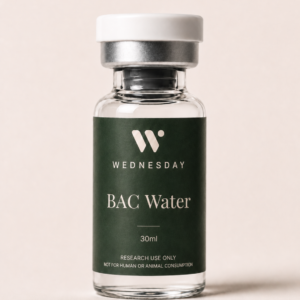 Reconstitution Support
BAC Water 30 mL
30 mL View listing →
Reconstitution Support
BAC Water 30 mL
30 mL View listing →
Frequently asked questions
What is bacteriostatic water?
Bacteriostatic Water for Injection, USP, is sterile water containing 0.9 percent benzyl alcohol as an antimicrobial preservative. It is supplied in multiple-dose vials and used as a diluent or solvent for drugs supplied as powders. It contains no salts or buffers.
What is the difference between bacteriostatic water and sterile water?
The preservative. Sterile water has none and is intended for single use, with any remainder discarded. Bacteriostatic water contains benzyl alcohol, which inhibits growth of organisms introduced after opening, allowing the vial to be used over a limited period, conventionally 28 days.
Does bacteriostatic water kill bacteria?
It inhibits their growth rather than reliably killing them; that is what bacteriostatic means. It is a safeguard against low-level contamination of an opened vial, not a means of sterilizing a contaminated solution, and it has no effect on endotoxin.
Why does bacteriostatic water say not for use in newborns?
Because of the gasping syndrome identified in 1982, in which premature infants exposed to cumulative benzyl alcohol from preserved flush solutions developed fatal metabolic acidosis. Neonates metabolize benzyl alcohol slowly. All preserved parenteral products now carry this warning.
Can benzyl alcohol affect peptide stability?
It can. Aromatic preservatives have been shown to promote aggregation of some proteins in solution. Short peptides are generally less affected than large proteins, but the effect depends on the sequence and must be assessed under the actual conditions of use rather than assumed.
References & further reading
- Hospira, Inc. Bacteriostatic Water for Injection, USP: prescribing information. DailyMed, US National Library of Medicine. dailymed.nlm.nih.gov
- Meyer BK, Ni A, Hu B, Shi L. Antimicrobial preservative use in parenteral products: past and present. J Pharm Sci. 2007;96(12):3155-3167. doi:10.1002/jps.20976 / PMID 17722087
- American Society of Health-System Pharmacists. Crosswalk of Guidance and Standards for Managing Single- and Multi-Dose Vials (USP <797> CDC). ashp.org
- Gershanik J, Boecler B, Ensley H, McCloskey S, George W. The gasping syndrome and benzyl alcohol poisoning. N Engl J Med. 1982;307(22):1384-1388. doi:10.1056/NEJM198211253072206 / PMID 7133084
- Nair B. Final report on the safety assessment of benzyl alcohol, benzoic acid, and sodium benzoate. Int J Toxicol. 2001;20(Suppl 3):23-50. doi:10.1080/10915810152630729 / PMID 11766131