Key takeaways
- Nitric oxide (NO) is a short-lived gas made by NO synthase enzymes that relaxes blood vessels, protects the gut lining and regulates blood flow to healing tissue.
- In rat experiments dating from 1997, BPC-157 counteracted both the effects of blocking NO synthesis with L-NAME and the effects of flooding the system with the NO precursor L-arginine.
- Independent cell studies have since traced a molecular route: BPC-157 activates endothelial NO synthase through VEGFR2–Akt signaling and through the Src–caveolin-1 pathway, increasing NO output from vessel-lining cells.
- All of this evidence comes from rodents and cultured cells; no human study has measured NO-related endpoints after BPC-157, and the compound is not an approved drug.
If a single theme runs through three decades of BPC-157 research, it is nitric oxide. The compound’s originating laboratory began invoking the “NO system” in the mid-1990s, long before any receptor or signaling pathway had been proposed, and has returned to it in nearly every review since. For years that association rested on pharmacological experiments in rats, blocking or boosting NO and watching what BPC-157 did to the result, without a molecular explanation. More recently, two independent groups have supplied candidate mechanisms at the level of the endothelial cell. This note explains what nitric oxide does, what the original experiments showed, what the newer cell biology adds, and where the account is still incomplete.
Nitric oxide in one paragraph
Nitric oxide is a diatomic gas that cells synthesize from the amino acid L-arginine using a family of enzymes called nitric oxide synthases (NOS). Three isoforms exist: endothelial (eNOS), which lines blood vessels and keeps them relaxed; neuronal (nNOS); and inducible (iNOS), which immune cells switch on during inflammation and which produces far larger amounts. NO diffuses across membranes and, in smooth muscle, activates guanylate cyclase to produce cyclic GMP, causing relaxation and increased blood flow.1 In the stomach, NO produced by the mucosa is part of the defense that keeps acid from damaging the lining. Pharmacologists study the system with two classic tools: L-NAME (NG-nitro-L-arginine methyl ester), which inhibits all NOS isoforms and so raises blood pressure and makes the gut more vulnerable to injury, and L-arginine itself, which supplies excess substrate and lowers blood pressure.2 A compound’s response to these two probes tells you something about whether, and how, it engages NO signaling.
The 1997 experiments
Sikiric and colleagues published the foundational study in the European Journal of Pharmacology in 1997.3 In rats, L-NAME produced gastric mucosal lesions and raised blood pressure, as expected; L-arginine lowered blood pressure and, in this model, also produced some gastric injury. BPC-157 given alongside L-NAME reduced both the lesions and the hypertension. Given alongside L-arginine, it reduced the hypotension. Given alone, it had no measurable effect on blood pressure. The authors’ interpretation was that BPC-157 did not simply act as an NO donor or an NO blocker; it appeared to push the system back toward its normal set point from either direction. That “bidirectional” pattern has been the group’s central claim about the NO relationship ever since.
Later work from the same laboratory reported that BPC-157 stimulated NO release from rat gastric mucosa preparations in vitro, and did so even in the presence of L-NAME, an observation that, if correct, implies either that BPC-157 acts on NOS in a way L-NAME does not fully block or that it engages an NO source independent of the enzyme. The group’s 2014 review collects these and dozens of related findings in models ranging from arrhythmia to alcohol intoxication, in each case reporting that BPC-157 opposed the disturbance produced by L-NAME or L-arginine.4 One example is a 2009 study in which BPC-157 reduced arrhythmias induced by the cardiac drug methyldigoxin in rats, with the effect modified by L-NAME and L-arginine co-treatment.5
For fifteen years the nitric oxide claim was an observation without a mechanism; the mechanism, when it arrived, came from laboratories that had never worked on BPC-157 before.
The molecular link: VEGFR2, Akt and eNOS
The first mechanistic account came from Hsieh and colleagues in Taiwan, who were studying BPC-157’s effect on blood-vessel growth. In human umbilical vein endothelial cells, BPC-157 increased phosphorylation and expression of VEGFR2, the main receptor for vascular endothelial growth factor. Downstream of VEGFR2 they found activation of the kinase Akt and, in turn, phosphorylation of eNOS at the serine residue that switches the enzyme on. Blocking VEGFR2 with a pharmacological inhibitor prevented the Akt and eNOS activation and abolished the pro-angiogenic effect in tube-formation and vessel-growth assays.6 This placed BPC-157 upstream of eNOS through a well-characterized growth-factor pathway, and offered an explanation for the increased blood-vessel formation repeatedly noted in the Zagreb wound studies.
A second route: Src and caveolin-1
In 2020 the same group examined vascular tone directly.7 In isolated rat aortic rings, BPC-157 produced relaxation that depended on an intact endothelium and was blocked by L-NAME, indicating an NO-mediated effect. In endothelial cells, BPC-157 increased NO production and eNOS phosphorylation, and the authors traced this to activation of the kinase Src and phosphorylation of caveolin-1, a membrane protein that normally holds eNOS in an inactive state. Phosphorylating caveolin-1 releases the brake. Two distinct pathways into the same enzyme, VEGFR2–Akt and Src–caveolin-1, converging on eNOS activation is a coherent molecular story, and it is consistent with the vasodilatory and cytoprotective effects the earlier pharmacology described.
| Study | System | NO-related finding | Group |
|---|---|---|---|
| Sikiric et al. 19973 | Rat, in vivo | Counteracted L-NAME lesions and hypertension; counteracted L-arginine hypotension | Zagreb (originating) |
| Balenovic et al. 20095 | Rat, in vivo | Reduced drug-induced arrhythmias; interaction with L-NAME and L-arginine | Zagreb |
| Sikiric et al. 20144 | Review of rat studies | Bidirectional modulation across many models; NO release from gastric tissue in vitro | Zagreb |
| Hsieh et al. 20176 | Human endothelial cells; chick membrane; rat ischemia | VEGFR2 → Akt → eNOS phosphorylation; blocked by VEGFR2 inhibitor | Taiwan (independent) |
| Hsieh et al. 20207 | Rat aortic rings; endothelial cells | Endothelium-dependent, L-NAME-sensitive relaxation; Src → caveolin-1 → eNOS | Taiwan (independent) |
What the mechanism explains, and what it does not
The eNOS findings account well for one half of the 1997 result: if BPC-157 activates eNOS, then in an L-NAME-treated animal where NOS is inhibited, a compound that increases the enzyme’s activity or output could partially restore NO and protect the gut and vessels. They account less well for the other half. A pure eNOS activator should add to L-arginine’s hypotensive effect, not oppose it. Either BPC-157 has additional actions on vascular tone, the Zagreb group has variously invoked effects on prostaglandins, on the sympathetic system and on a broad “cytoprotective” program, or the L-arginine results reflect something about the model that is not yet understood. Independent replication of the L-arginine findings would clarify this, and none has been published.
A second caution concerns the breadth of the Zagreb claims. The 2014 review and its successors report that BPC-157 normalizes NO-related disturbances in a remarkable range of organ systems, gastrointestinal, cardiovascular, neurological, muscular, and a compound that improves nearly every model it is tested in should prompt questions about study design and outcome assessment as much as about biology.8 The Taiwan studies are narrower, use standard assays, and are more informative for that reason; but each is a single publication from one laboratory, and the 2020 vasomotor findings in particular await confirmation.
Reading the evidence
Every finding described here is from rats or cultured cells. No study has measured NO production, blood pressure, endothelial function or any vascular endpoint in humans after BPC-157, and the compound has no approved use anywhere. Claims that BPC-157 “improves blood flow” or “supports vascular health” in people are extrapolations from this preclinical record, not results. Research-grade BPC-157 is a laboratory reagent.
Why the NO connection matters for tissue-repair research
Nitric oxide sits at the center of wound healing. Early after injury, iNOS-derived NO from immune cells helps clear debris and drives inflammation; later, eNOS-derived NO promotes the growth of new vessels that bring oxygen and nutrients to the repairing tissue, and NO signaling influences fibroblast behavior and collagen deposition. A compound that activates eNOS in endothelial cells therefore has a plausible route to the effects reported in the tendon, ligament and gastric models summarized in the BPC-157 research overview. The 2021 review by Seiwerth and colleagues makes exactly this argument, positioning the NO system and VEGFR2 as the shared thread connecting the group’s wound-healing observations.8
For researchers, the NO literature suggests specific, testable experiments: measuring eNOS phosphorylation and NO metabolites in treated versus untreated tissue, using eNOS-knockout animals to see whether the healing effects disappear, and repeating the L-arginine experiments in a second laboratory with blinded scoring. Those studies would settle whether the NO system is the mechanism, one mechanism among several, or a correlate. When BPC-157 is studied alongside thymosin β4 fragments, as in the BPC-157 vs. TB-500 comparison, it is worth noting that Tβ4’s repair biology runs through actin and cell migration rather than NO, so the two compounds engage distinct systems. Per-lot identity and purity data for Wednesday’s BPC-157 are in the COA library.
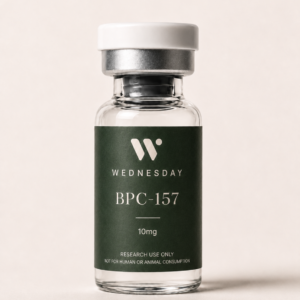 Tissue Repair Research
BPC-157
10 mg, third-party tested View listing →
Tissue Repair Research
BPC-157
10 mg, third-party tested View listing →
Frequently asked questions
Does BPC-157 increase nitric oxide?
In cultured human endothelial cells, BPC-157 increased nitric oxide production by activating the enzyme eNOS through two signaling routes, VEGFR2–Akt and Src–caveolin-1. In isolated rat blood vessels it caused NO-dependent relaxation. Whether it changes NO levels in a living human has not been studied.
What is L-NAME and why is it used in BPC-157 studies?
L-NAME is a drug that blocks all nitric oxide synthase enzymes, which raises blood pressure and makes the stomach lining more vulnerable to injury in animals. Researchers give it alongside a test compound to see whether that compound’s effects depend on nitric oxide. In rats, BPC-157 reduced the lesions and hypertension L-NAME produced.
How does BPC-157 affect blood pressure?
In the 1997 rat study, BPC-157 alone did not change blood pressure, but it reduced the rise caused by L-NAME and the fall caused by L-arginine. Isolated rat artery segments relaxed in response to BPC-157 in a 2020 study. No human blood-pressure data exist.
What is the connection between BPC-157 and VEGFR2?
A 2017 study found that BPC-157 activated VEGFR2, the main receptor for vascular endothelial growth factor, on endothelial cells. This triggered the kinase Akt and then eNOS, linking the peptide to both new blood-vessel growth and nitric oxide production. The finding is from one laboratory and has not yet been independently replicated.
Is the BPC-157 nitric oxide research done in humans?
No. All published work on BPC-157 and nitric oxide uses rats, chick embryos or cultured cells. BPC-157 has no published controlled human trials for any endpoint and is not an approved drug in any country.
References & further reading
- Förstermann U, Sessa WC. Nitric oxide synthases: regulation and function. Eur Heart J. 2012;33(7):829–837. doi:10.1093/eurheartj/ehr304 / PMID 21890489
- Moncada S, Higgs A. The L-arginine-nitric oxide pathway. N Engl J Med. 1993;329(27):2002–2012. doi:10.1056/NEJM199312303292706 / PMID 7504210
- Sikiric P, Seiwerth S, Grabarevic Z, et al. The influence of a novel pentadecapeptide, BPC 157, on NG-nitro-L-arginine methylester and L-arginine effects on stomach mucosa integrity and blood pressure. Eur J Pharmacol. 1997;332(1):23–33. doi:10.1016/S0014-2999(97)01033-9
- Sikiric P, Seiwerth S, Rucman R, et al. Stable gastric pentadecapeptide BPC 157-NO-system relation. Curr Pharm Des. 2014;20(7):1126–1135. doi:10.2174/13816128113190990411
- Balenovic D, Bencic ML, Udovicic M, et al. Inhibition of methyldigoxin-induced arrhythmias by pentadecapeptide BPC 157: a relation with NO-system. Regul Pept. 2009;156(1–3):83–89. doi:10.1016/j.regpep.2009.05.008
- Hsieh MJ, Liu HT, Wang CN, et al. Therapeutic potential of pro-angiogenic BPC157 is associated with VEGFR2 activation and up-regulation. J Mol Med (Berl). 2017;95(3):323–333. doi:10.1007/s00109-016-1488-y
- Hsieh MJ, Lee CH, Chueh HY, et al. Modulatory effects of BPC 157 on vasomotor tone and the activation of Src-Caveolin-1-endothelial nitric oxide synthase pathway. Sci Rep. 2020;10:17078. doi:10.1038/s41598-020-74022-y
- Seiwerth S, Milavic M, Vukojevic J, et al. Stable gastric pentadecapeptide BPC 157 and wound healing. Front Pharmacol. 2021;12:627533. doi:10.3389/fphar.2021.627533