Key takeaways
- Selank and Semax were developed by the same Moscow institute and share a Pro-Gly-Pro stabilizing tail, but they derive from different parent peptides: tuftsin and ACTH respectively.
- Selank research centers on anxiolytic-type behavior in rodents and on GABAergic gene expression; Semax research centers on BDNF, TrkB and ischemia models.
- Both inhibit enkephalin-degrading enzymes in vitro, the one mechanism they demonstrably share.
- Both are registered medicines in Russia with limited, mostly Russian-language clinical evidence; neither has been evaluated by Western regulators.
Selank and Semax are often grouped together, and for understandable reasons. Both are seven-residue synthetic peptides, both came out of the Institute of Molecular Genetics of the Russian Academy of Sciences, both end in the same protective tripeptide, and both are sold in Russia as nasal solutions. But the resemblance is architectural rather than pharmacological. One was built from a fragment of a stress hormone to influence cognition; the other was built from a fragment of an immune peptide to reduce anxiety-like behavior. This note sets the two side by side, origin, sequence, proposed mechanism, animal findings and clinical record, so that a researcher choosing between them, or studying them together, can see where the literature actually diverges.
Shared origins, different parents
The design logic behind both peptides is the same. Take a short, biologically active fragment of a native peptide that is degraded too quickly to be useful, and append Pro-Gly-Pro (PGP) to the C-terminus to slow enzymatic breakdown. The PGP tail is a signature of the Moscow program and appears in several of its compounds.
Semax is Met-Glu-His-Phe-Pro-Gly-Pro: the ACTH(4-7) fragment plus PGP. Its parent, ACTH(4-10), had been studied since the 1970s for effects on attention and learning that were independent of adrenal stimulation. The full background is in Semax: A Review of Neuropeptide Research.
Selank is Thr-Lys-Pro-Arg-Pro-Gly-Pro: the tetrapeptide tuftsin plus PGP. Tuftsin is a fragment of the Fc region of immunoglobulin G, first characterized for stimulating phagocytosis. The decision to build an anxiolytic on an immune peptide was driven by observations that tuftsin itself altered behavior in animals, and it means Selank’s literature has an immunological strand, cytokine and interleukin expression, that Semax’s largely lacks.1
Proposed mechanisms
Semax: neurotrophins
The dominant mechanistic story for Semax is transcriptional regulation of neurotrophins. Dolotov and colleagues showed that intranasal Semax increased BDNF protein and TrkB receptor expression in rat hippocampus within hours,2 and rat glial cultures respond with rapid induction of BDNF and NGF mRNA.3 Genome-wide studies in rat ischemia models describe broad changes in immune, vascular and neurotrophin-related transcripts.4 No molecular receptor has been identified.
Selank: GABA and enkephalins
Selank’s literature points elsewhere. Volkova and colleagues reported that Selank administration in rodents altered expression of a set of genes involved in GABAergic neurotransmission, including GABA-A receptor subunits, in a pattern that overlapped with the effects of GABA itself.5 Follow-up work in a human neuroblastoma line (IMR-32) found that Selank, GABA and olanzapine produced partly convergent changes in GABAergic gene expression.6 Earlier binding work had suggested Selank may act as an allosteric modulator at GABA-A receptors, though direct electrophysiological confirmation is thin. A second strand proposes enkephalinase inhibition: Selank slows breakdown of endogenous enkephalins in serum, which could contribute to anxiolytic-type effects through opioid signaling.7
The overlap
The one mechanism both peptides share on direct evidence is enzyme inhibition. Kost and colleagues tested Semax and Selank together and found that both inhibited the enkephalin-degrading enzymes of human serum.7 Beyond that, the two literatures rarely test the same endpoints, which is part of why they are hard to compare rigorously.
Two peptides can share a tail, a laboratory and a delivery route and still be answers to entirely different questions.
Side-by-side comparison
| Semax | Selank | |
|---|---|---|
| Sequence | Met-Glu-His-Phe-Pro-Gly-Pro | Thr-Lys-Pro-Arg-Pro-Gly-Pro |
| Parent peptide | ACTH(4-7), a hormone fragment | Tuftsin, an IgG-derived immunopeptide |
| Stabilizing tail | Pro-Gly-Pro | Pro-Gly-Pro |
| Principal mechanism studied | BDNF/TrkB and neurotrophin transcription2,3 | GABAergic gene expression; enkephalinase inhibition5,7 |
| Main animal models | Cerebral ischemia; hippocampal gene expression | Anxiety-like behavior; stress-induced cytokine changes1 |
| Russian indications | Ischemic stroke, cognitive impairment, optic nerve disorders | Generalized anxiety disorder, neurasthenia |
| Key clinical reports | Stroke cohorts, 2018 summary8 | GAD trials vs. benzodiazepine comparators9,10 |
| Western regulatory status | None | None |
Animal findings
Semax’s animal work is weighted toward molecular endpoints in injury models. Rat focal ischemia and ischemia–reperfusion studies report reduced inflammatory transcripts and altered protein expression consistent with protection,4 and older behavioral work described improved performance on learning tasks. Infarct-volume and long-term functional outcomes, the standard neuroprotection endpoints, are less well represented.
Selank’s animal work is weighted toward behavior. Rodent studies using elevated plus-maze and open-field paradigms report reduced anxiety-like behavior, and stress-model studies report normalization of cytokine levels, including interleukin-6, after “social” stress.1 A consistent theme is that Selank produced anxiolytic-type effects without the sedation or motor impairment that benzodiazepines cause in the same paradigms, an observation that motivated the human comparator trials.
The clinical record in Russia
Both compounds are registered in Russia and both have clinical literatures published largely in Zhurnal Nevrologii i Psikhiatrii imeni S.S. Korsakova with English abstracts.
For Semax, a 2018 report summarized outcomes in patients treated at different stages of ischemic stroke and described improved functional recovery.8 For Selank, Zozulya and colleagues in 2008 reported efficacy in generalized anxiety disorder and neurasthenia and proposed mechanisms including effects on enkephalin metabolism and cytokine balance;9 a 2014 comparison with the benzodiazepine phenazepam reported comparable anxiolytic effect with better tolerability for Selank.10
Selank’s clinical literature also includes an immunological thread absent from Semax’s: a 2008 report described changes in cytokine and interleukin profiles in patients with anxiety-asthenic disorders, consistent with the tuftsin origin of the molecule. Whether those changes are causally linked to any behavioral effect, or simply accompany it, the studies could not determine.
The same caveats apply to both. Trials were small, often open-label or without placebo, and outcomes relied on rating scales without independent blinded assessment. Neither compound has had a systematic review by Cochrane or an equivalent body, and neither dossier has been examined by a Western regulator. Researchers should read these reports as evidence that the compounds have been given to people under medical supervision, not as evidence of efficacy at the standard a modern approval would require.
Reading the evidence
When comparing two compounds, ask whether the studies measured the same thing. Semax and Selank are rarely tested head-to-head, and their literatures use different endpoints, gene expression in injured brain versus behavior in stressed animals. The differences between them partly reflect what each laboratory chose to measure.
Which one do researchers study, and for what?
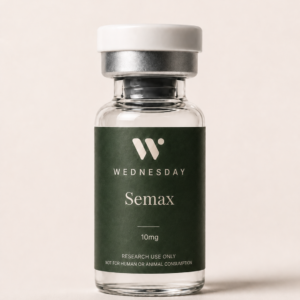
A laboratory interested in neurotrophin signaling, hippocampal gene expression or ischemic injury has a substantial Semax literature to build on; the BDNF findings in particular are replicated enough to serve as a positive control in expression assays. A laboratory interested in GABAergic modulation, stress-related cytokine changes or anxiety-like behavior will find more precedent with Selank. Studies that administer both, or compare them directly, are rare, and the enkephalinase finding is one of the few places the two literatures meet. Wednesday’s catalog currently lists Semax for research; a broader discussion of the neuropeptide field is in Neuroprotective Peptides: An Overview.
 Cellular Energy & Neuro Research
Semax
10 mg View listing →
Cellular Energy & Neuro Research
Semax
10 mg View listing →
Frequently asked questions
What is the difference between Selank and Semax?
Semax is derived from the ACTH(4-7) fragment of adrenocorticotropic hormone and is studied mainly for effects on BDNF, TrkB and ischemic injury. Selank is derived from the immunopeptide tuftsin and is studied mainly for anxiolytic-type behavior and GABAergic gene expression. Both carry a Pro-Gly-Pro tail added for stability.
Do Selank and Semax work the same way?
No. The only mechanism both share on direct evidence is inhibition of enkephalin-degrading enzymes in vitro. Semax’s primary literature concerns neurotrophin transcription; Selank’s concerns GABA-A-related gene expression and cytokine modulation.
Are Selank and Semax approved drugs?
Both are registered in Russia as nasal solutions, Semax for stroke and cognitive indications, Selank for anxiety disorders. Neither has been approved or reviewed by the FDA, EMA or comparable regulators.
Is Selank a GABA agonist?
Not in the classical sense. Rodent and cell-line studies show that Selank alters expression of genes involved in GABAergic neurotransmission, and some work suggests allosteric modulation of GABA-A receptors, but it is not a direct agonist at the GABA binding site and the electrophysiological evidence is limited.
Why are both peptides given intranasally in Russia?
Both are small, and the Russian pharmaceutical products are formulated as nasal drops on the rationale that this route offers a path toward the central nervous system. This describes the registered medicines, not research-grade material, which is sold for laboratory use only.
References & further reading
- Uchakina ON, Uchakin PN, Miasoedov NF, et al. The influence of Selank on the level of cytokines under the conditions of “social” stress. Eksp Klin Farmakol. 2020;83(2):3–8. PMID 32621722
- Dolotov OV, Karpenko EA, Inozemtseva LS, et al. Semax, an analog of ACTH(4-10) with cognitive effects, regulates BDNF and trkB expression in the rat hippocampus. Brain Res. 2006;1117(1):54–60. doi:10.1016/j.brainres.2006.07.108 / PMID 16996037
- Shadrina MI, Dolotov OV, Grivennikov IA, et al. Rapid induction of neurotrophin mRNAs in rat glial cell cultures by Semax, an adrenocorticotropic hormone analog. Neurosci Lett. 2001;308(2):115–118. PMID 11457573
- Medvedeva EV, Dmitrieva VG, Limborska SA, et al. The peptide semax affects the expression of genes related to the immune and vascular systems in rat brain focal ischemia: genome-wide transcriptional analysis. BMC Genomics. 2014;15:228. doi:10.1186/1471-2164-15-228
- Volkova A, Shadrina M, Kolomin T, et al. Selank administration affects the expression of some genes involved in GABAergic neurotransmission. Front Pharmacol. 2016;7:31. doi:10.3389/fphar.2016.00031 / PMID 26924987
- Filippenkov IB, Stavchansky VV, Glazova NY, et al. GABA, Selank, and olanzapine affect the expression of genes involved in GABAergic neurotransmission in IMR-32 cells. Front Pharmacol. 2017;8:89. doi:10.3389/fphar.2017.00089 / PMID 28293190
- Kost NV, Sokolov OIu, Gabaeva MV, et al. Semax and selank inhibit the enkephalin-degrading enzymes from human serum. Bioorg Khim. 2001;27(3):180–183. PMID 11443939
- Gusev EI, Martynov MYu, Kostenko EV, et al. The efficacy of semax in the treatment of patients at different stages of ischemic stroke. Zh Nevrol Psikhiatr Im S S Korsakova. 2018;118(3 Pt 2):61–68. PMID 29798983
- Zozulya AA, Neznamov GG, Syunyakov TS, et al. Efficacy and possible mechanisms of action of a new peptide anxiolytic selank in the therapy of generalized anxiety disorders and neurasthenia. Zh Nevrol Psikhiatr Im S S Korsakova. 2008;108(4):38–48. PMID 18454096
- Medvedev VE, Tereshchenko ON, Kost NV, et al. A comparison of the anxiolytic effect and tolerability of selank and phenazepam in the treatment of anxiety disorders. Zh Nevrol Psikhiatr Im S S Korsakova. 2014;114(7):17–22. PMID 25176261