Key takeaways
- Semax is a synthetic heptapeptide derived from the ACTH(4-10) fragment, engineered so that it retains the fragment’s neurotropic activity without the hormonal effects of the parent molecule.
- The most replicated preclinical finding is an increase in BDNF and TrkB expression in rat hippocampus and basal forebrain within hours of administration.
- Semax is a registered medicine in Russia, where it has been studied in ischemic stroke; almost all clinical data come from Russian-language journals with methodological limits.
- Research-grade Semax sold for laboratory use is not the Russian pharmaceutical product, and none of the human findings transfer to it.
Semax occupies an unusual position in peptide research. It was designed in the Soviet Union in the 1980s at the Institute of Molecular Genetics as a deliberately modified fragment of adrenocorticotropic hormone (ACTH), stabilized so that it would survive long enough in tissue to act on the brain. It later became a registered drug in Russia, which means it has a body of human data that most research peptides lack. At the same time, it has never been evaluated by the FDA or EMA, and the mechanistic literature, largely from a small number of Moscow laboratories, is still filling in how a seven-residue peptide changes gene expression in neurons. This note reviews that literature: the molecule, the neurotrophin findings, the ischemia models, the Russian clinical record, and the limits of what any of it establishes.
What Semax is
ACTH is a 39-amino-acid hormone whose central fragment, ACTH(4-10), was known by the 1970s to influence attention and learning in animals independently of its effects on the adrenal cortex. The problem was stability: the native fragment is degraded in minutes. Semax was the answer. Its sequence is Met-Glu-His-Phe-Pro-Gly-Pro, the first four residues of ACTH(4-7) followed by a C-terminal Pro-Gly-Pro (PGP) tripeptide that resists enzymatic cleavage and extends the peptide’s half-life in the body.1 The PGP fragment is itself biologically active and is studied separately as a product of Semax breakdown.
Because Semax lacks the residues that bind melanocortin receptors on the adrenal gland, it does not raise cortisol. This separation of the “neurotropic” from the “hormonal” activity of ACTH is the whole design rationale, and it is why the compound is described in the literature as a melanocortin-derived neuropeptide rather than a hormone analogue.
The BDNF and TrkB findings
The finding that anchors Semax research is its effect on brain-derived neurotrophic factor (BDNF). In 2006, Dolotov and colleagues reported that a single intranasal administration of Semax to rats increased BDNF protein and TrkB receptor expression in the hippocampus, with changes detectable within hours.1 A companion study the same year showed specific binding of Semax in rat basal forebrain and a rise in BDNF protein there.2 The pattern, more neurotrophin and more receptor for it, suggested that Semax could shift the hippocampus toward a state that supports synaptic plasticity.
Earlier work had pointed in the same direction. Shadrina and colleagues reported in 2001 that Semax rapidly induced BDNF and NGF mRNA in cultured rat glial cells.3 Later time-course studies compared NGF and BDNF gene expression across hippocampus, frontal cortex and retina and found region-specific responses, with the hippocampus responding most consistently.4 These are all rodent or cell-culture findings; no study has measured BDNF in human brain after Semax, and peripheral blood BDNF is a poor proxy for central levels.
Semax is best understood not as a stimulant but as a transcriptional nudge, a peptide that changes which genes neurons and glia are reading.
Ischemia and neuroprotection models
The Russian clinical use of Semax is in ischemic stroke, and much of the recent mechanistic work uses rat models of cerebral ischemia to ask what the peptide does in injured tissue. Whole-genome expression studies from the Institute of Molecular Genetics have reported that Semax administered after focal ischemia alters transcripts related to the immune response and vascular function, generally toward reduced inflammation.5 Follow-up transcriptomic and proteomic analyses of ischemia–reperfusion have described suppression of pro-inflammatory mediators and shifts in protein expression consistent with a protective effect.6 Semax and its PGP fragment have also been reported to activate transcription of neurotrophins and their receptors after cerebral ischemia.7
Two features of this literature deserve note. First, it is largely produced by one research network, so independent replication outside Russia is limited. Second, the outcomes are molecular, gene and protein expression, rather than behavioral or histological measures of infarct size, which are the standard for neuroprotection claims in stroke pharmacology. The transcriptomic data are consistent with a protective effect; they are not the same thing as demonstrating one.
Enkephalinase inhibition and other mechanisms
A less-cited but reproducible mechanism is enzyme inhibition. Kost and colleagues showed that Semax and its relative Selank inhibit the enkephalin-degrading enzymes of human serum.8 Enkephalins are endogenous opioid peptides, and slowing their breakdown could plausibly contribute to any behavioral effects; this is the same mechanism proposed for Selank’s anxiolytic profile, discussed in the sibling note Selank vs. Semax. Semax has also been reported to influence dopaminergic and serotonergic turnover in rat striatum, though these results are older and less consistent than the neurotrophin data.
The Russian clinical record
Semax has been registered in Russia since the 1990s as a nasal solution, with indications that have included acute ischemic stroke, optic nerve disorders, and post-stroke cognitive impairment. A 2018 publication in Zhurnal Nevrologii i Psikhiatrii summarized efficacy data across stages of ischemic stroke, reporting improved functional recovery in treated patients.9 Earlier open-label and comparative studies from the same tradition reported similar outcomes.
These trials are difficult to appraise. Many were not placebo-controlled, sample sizes were modest, outcomes were sometimes rating scales without blinded assessment, and publication was in Russian with English abstracts only. A Cochrane review on a different Russian-registered neuropeptide product, Cerebrolysin, illustrates what happens when such literatures are evaluated by systematic-review standards: the pooled evidence did not support a benefit in acute ischemic stroke.10 Semax has not had an equivalent systematic review, and no Western regulator has evaluated the data. Researchers should treat the clinical record as hypothesis-generating rather than confirmatory.
Reading the evidence
Registration in one country is a regulatory fact, not a scientific verdict. Semax’s Russian approval tells you that a national regulator accepted a dossier; it does not tell you that the trials would satisfy contemporary standards for randomization, blinding and pre-registration. Weight the preclinical mechanism work and the clinical claims separately.
Preclinical vs. clinical: where the evidence sits
| Domain | Model | Principal observation | Strength |
|---|---|---|---|
| Neurotrophin expression | Rat hippocampus, basal forebrain; glial culture | Increased BDNF and TrkB within hours1,2,3 | Replicated across several studies, one research network |
| Ischemia transcriptomics | Rat focal ischemia and ischemia–reperfusion | Reduced inflammatory transcripts, altered vascular and neurotrophin genes5,6,7 | Molecular endpoints only |
| Enzyme inhibition | Human serum in vitro | Inhibition of enkephalin-degrading enzymes8 | Biochemical, mechanism unconfirmed in vivo |
| Clinical | Russian stroke cohorts | Reported functional improvement9 | Limited blinding, no independent review |
Handling and stability for laboratory work
Semax is supplied as a lyophilized powder for research. Like most short peptides with a methionine residue, it is susceptible to oxidation, so storage away from light and moisture matters; general guidance is in Peptide Storage and Handling. Because PGP is a degradation product with its own activity, an analytical method that resolves the intact heptapeptide from its fragments is useful when verifying identity and purity, see the certificate library at /coa/ for how Wednesday reports HPLC and mass-spectrometry data.
What remains open
Three questions define the research agenda. What is the receptor? Binding studies show specific sites in basal forebrain, but a molecular target has not been cloned, and the leading hypothesis, that Semax acts through melanocortin receptors in an unusual way, is unproven. Do the transcriptional changes translate to structural or functional neuroprotection in models with hard endpoints? And would any of this hold in a well-controlled human trial run outside Russia? Until those are answered, Semax remains a well-characterized tool for studying neurotrophin regulation, and a compound whose clinical narrative outruns its independent evidence.
 Cellular Energy & Neuro Research
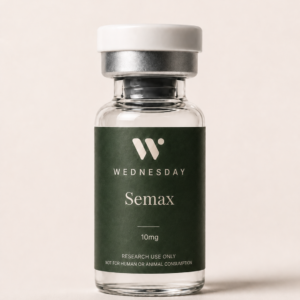
Semax
10 mg View listing →
Cellular Energy & Neuro Research
Semax
10 mg View listing →
Frequently asked questions
What is Semax and what is it derived from?
Semax is a synthetic seven-amino-acid peptide (Met-Glu-His-Phe-Pro-Gly-Pro) derived from the ACTH(4-10) fragment of adrenocorticotropic hormone. The C-terminal Pro-Gly-Pro was added to resist enzymatic breakdown. It retains the neurotropic activity of the ACTH fragment without stimulating cortisol release.
Does Semax increase BDNF?
In rats, single intranasal doses increased BDNF protein and TrkB receptor expression in the hippocampus and basal forebrain within hours, and Semax induced BDNF and NGF mRNA in cultured glial cells. These are animal and in vitro findings; there is no human brain measurement.
Is Semax an approved drug?
Semax is registered in Russia as a nasal solution, historically for ischemic stroke and related indications. It has not been approved or reviewed by the FDA, EMA or comparable regulators, and the Russian trials have not been independently systematically reviewed.
Is research-grade Semax the same as the Russian medicine?
No. Research-grade Semax is a laboratory reagent sold for in vitro and preclinical use. It is not manufactured or labeled as a pharmaceutical, and clinical findings from the Russian product do not apply to it.
How is Semax related to Selank?
Both are heptapeptides from the same Moscow research program and both carry the Pro-Gly-Pro stabilizing tail, but Semax derives from ACTH and Selank from the immunopeptide tuftsin. Their research profiles differ: Semax is studied mainly for neurotrophin and ischemia effects, Selank for anxiolytic and GABAergic effects.
References & further reading
- Dolotov OV, Karpenko EA, Inozemtseva LS, et al. Semax, an analog of ACTH(4-10) with cognitive effects, regulates BDNF and trkB expression in the rat hippocampus. Brain Res. 2006;1117(1):54–60. doi:10.1016/j.brainres.2006.07.108 / PMID 16996037
- Dolotov OV, Karpenko EA, Seredenina TS, et al. Semax, an analogue of adrenocorticotropin (4-10), binds specifically and increases levels of brain-derived neurotrophic factor protein in rat basal forebrain. J Neurochem. 2006;97(Suppl 1):82–86. doi:10.1111/j.1471-4159.2006.03658.x
- Shadrina MI, Dolotov OV, Grivennikov IA, et al. Rapid induction of neurotrophin mRNAs in rat glial cell cultures by Semax, an adrenocorticotropic hormone analog. Neurosci Lett. 2001;308(2):115–118. PMID 11457573
- Dmitrieva VG, Povarova OV, Skvortsova VI, et al. Comparison of the temporary dynamics of NGF and BDNF gene expression in rat hippocampus, frontal cortex, and retina under Semax action. J Mol Neurosci. 2010;41(1):30–35. doi:10.1007/s12031-009-9270-z
- Medvedeva EV, Dmitrieva VG, Limborska SA, et al. The peptide semax affects the expression of genes related to the immune and vascular systems in rat brain focal ischemia: genome-wide transcriptional analysis. BMC Genomics. 2014;15:228. doi:10.1186/1471-2164-15-228
- Filippenkov IB, Stavchansky VV, Denisova AE, et al. Brain protein expression profile confirms the protective effect of the ACTH(4-7)PGP peptide (Semax) in a rat model of cerebral ischemia–reperfusion. Int J Mol Sci. 2021;22(12):6179. doi:10.3390/ijms22126179
- Dmitrieva VG, Dergunova LV, Povarova OV, et al. Semax and Pro-Gly-Pro activate the transcription of neurotrophins and their receptor genes after cerebral ischemia. Cell Mol Neurobiol. 2010;30(1):71–79. doi:10.1007/s10571-009-9432-0 / PMID 19633950
- Kost NV, Sokolov OIu, Gabaeva MV, et al. Semax and selank inhibit the enkephalin-degrading enzymes from human serum. Bioorg Khim. 2001;27(3):180–183. PMID 11443939
- Gusev EI, Martynov MYu, Kostenko EV, et al. The efficacy of semax in the treatment of patients at different stages of ischemic stroke. Zh Nevrol Psikhiatr Im S S Korsakova. 2018;118(3 Pt 2):61–68. PMID 29798983
- Ziganshina LE, Abakumova T, Hoyle CHV. Cerebrolysin for acute ischaemic stroke. Cochrane Database Syst Rev. 2020;7:CD007026. doi:10.1002/14651858.CD007026.pub6 / PMID 32662068